
Review · PRIVATE
Semi-Private French Revolution and Conciergerie tour
Paris turns political history into street scenes. On this semi-private French Revolution and Conciergerie walk, I love how on-foot sightseeing turns big events into street-level details you can actually see and point at. You also get a more personal experience with a small group, and your guide’s stories help the French Revolution feel real instead of textbook-stale. One thing to consider is that it runs in all weather and you’ll want moderate walking stamina, since this is a true street tour.
What makes this outing especially practical is the mix of major landmarks and less-famous angles. I like that you start with modern Paris at Opera Bastille, then move through places tied to politics, religion, and neighborhood change, ending near the Conciergerie. Guides behind the scenes, including Benoit, William, and Adam (names that have shown up in past experiences), are praised for bringing both the French Revolution and present-day Paris into the same conversation, and for sharing smart restaurant ideas.
For price, it’s not the cheapest option, but you are paying for a professional English-speaking guide and a semi-private group size capped at 15. If you only want a quick highlight loop with no story depth, this might feel like a lot. If you want your Paris to connect to the Revolution, it’s a strong deal for 2 hours 30 minutes of guided walking.
Key things to know before you go
- Semi-private group (max 15), so you get more back-and-forth than on large bus tours
- On-foot route that helps you notice details at Opera Bastille, Le Marais, and beyond
- Modern-to-historic pacing, starting at Opera Bastille and building toward Revolution-era sites
- Free admission for the listed stops, so you can focus on the tour instead of ticket math
- Professional English guide with story-driven explanations you can actually follow
- All-weather schedule, so dress for conditions and not just the forecast
Walking the Revolution route, from Opera Bastille to the Conciergerie
This tour works because it feels like a guided walk through the city’s layers. You start at Opera Bastille and finish at the Conciergerie area, so you move through Paris in a way that makes the timeline easier to hold in your head. I like that you are not just staring at plaques. You are walking past real architecture and neighborhood shapes, with context added as you go.
The pace is also a big part of the value. The total time is about 2 hours 30 minutes, which is long enough for a story to build but short enough that you still have energy left for dinner. You’ll cover a mix of well-known places and meaningful corners, which is ideal if you want to see Paris in a way that feels less like a checklist.
One practical note: this is near public transportation, and it ends in the 1st arrondissement area. That makes it easier to keep your day fluid. If you’re planning other sights after the tour, you’ll likely find it simpler to get going from the finish point than from the start.
You can also read our reviews of more private tours in Paris



Why the semi-private size makes the history feel personal
The group cap is 15, which is the sweet spot for this kind of tour. With smaller numbers, it’s easier for the guide to tailor explanations to what you’re asking, and it’s less chaotic when everyone needs to hear the same story. I also like that semi-private usually means you get more time with your guide rather than watching them rush ahead.
You’ll feel the difference in moments where history gets specific. The French Revolution is one of those topics where names, dates, and places can blur together fast. In a larger group, those details can slide past. In a small group, you’re more likely to ask, pause, and connect the dots as the guide is talking.
Past experiences with guides like Benoit, William, and Adam also highlight something that matters for your enjoyment: the tone is friendly, and the guide energy stays high. One booking even turned more intimate when nobody else was scheduled, which can make the whole thing feel closer to a private conversation with a historian who actually knows how to entertain. If you’re bringing teens, this format helps too, since the story tends to move at a human pace.
Opera Bastille: starting with modern Paris to frame the Revolution
You begin at Opera Bastille, a sleek auditorium opened in 1989. This stop isn’t about Revolution-era buildings. It’s about contrast, and that’s why I like it.
Starting modern gives your brain a clean page to work with. You get the feel of today’s Paris first, then the guide can pivot into how this city’s power structures and public spaces have changed over time. Even if you don’t care about opera, the setting helps you understand that history is not a museum exhibit. It’s something cities continuously remake.
Also, this stop is marked as free admission. That’s a practical win. You can focus on the guide’s framing instead of thinking about ticketing or entry logistics at the very start.
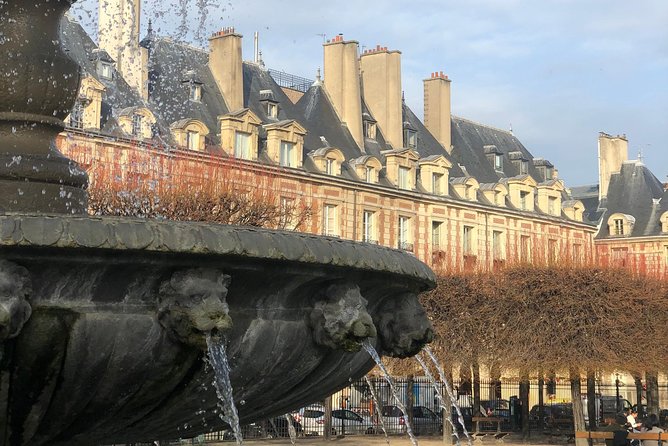
Le Marais: when a neighborhood’s past becomes part of its present
Next is Le Marais, one of Paris’s most famous districts, but with a twist. The tour explains that it was built on land filled from a swamp. That alone is a reminder that Paris is engineered as much as it is aesthetic.
What I find compelling here is the story of decline and comeback. The area once had a reputation for high culture, then fell into disrepair following the French Revolution, and later regained prominence. That sequence is more interesting than a simple “this is where rich people live” description.
Because you’re walking, you’re not just reading about the neighborhood. You’re taking in its layout and atmosphere in real time, which makes the comeback feel more believable. If you’ve ever visited Paris and wondered why some parts look like they’re wearing different eras at once, Le Marais is a great example.
Like the other listed stops, admission is free for this point. So you’re not paying extra to experience the setting the guide is using to explain how the Revolution reshaped the city.
Hotel de Ville: where government history meets visible public space
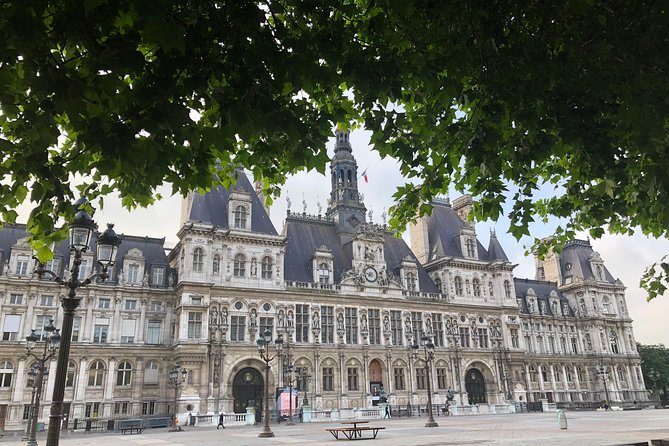
The route then goes to Hotel de Ville, a beautiful 19th-century building that now serves as the seat of the French government. This stop matters because it connects political power to a physical place you can see and understand.
If you only think of the Revolution as a set of dramatic events, you can miss how politics becomes routine. Hotel de Ville helps you keep both in view. The guide’s explanations and displays on French history give you a way to see how the story is presented and remembered, not only what happened during the Revolution itself.
A practical upside: this stop is also listed as free admission. For many sightseeing tours, you end up paying entry fees in one place or another. Here, you can spend that energy listening and looking instead of budgeting for doors you may or may not need to open.




Tour Saint-Jacques: a Gothic tower that survives the Revolution
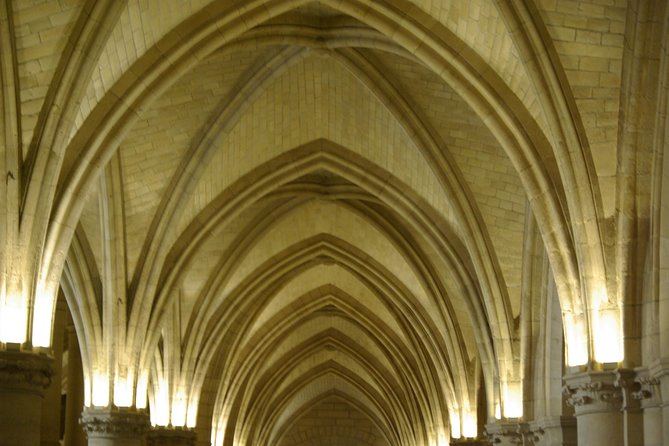
Tour Saint-Jacques is a Flamboyant Gothic tower from the 16th century. It is described as the only remains of the church of St Jacques de la Boucherie, which was demolished during the French Revolution. That detail is the kind of anchor your guide can use to explain why preservation and destruction are part of the same story.
I like this stop because it gives you a physical object tied to a specific consequence. Instead of talking abstractly about the Revolution’s changes, you can point at one structure and say, this is what made it through. That kind of concrete connection is how the topic stops feeling distant.
And again, admission is free for this stop. So you get a meaningful, visually striking Gothic landmark without extra ticket friction.
The Conciergerie finish: why the end point matters for the story
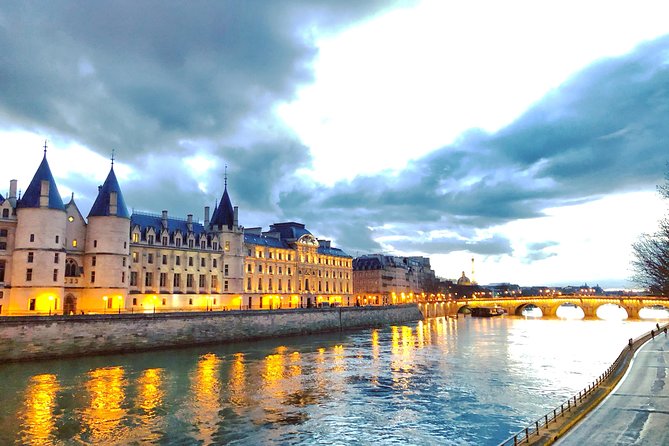
Your tour ends at the Conciergerie, near 2 Bd du Palais. Even though the walking route is focused on the points listed along the way, ending at the Conciergerie area gives you closure with a location tied to Revolution-era intrigue.
This matters because your brain processes the story by moving through space. When you finish at a site connected to the Revolution, you’re more likely to remember what the guide emphasized along the way, since everything you saw earlier starts to feel like it’s supporting the final chapter.
If you like planning your day with intention, this end point is also helpful. It keeps you in a central area where it’s easier to pair with other nearby sights and a well-timed meal.
What the guide does that makes the tour worth it
A walking tour can be good or it can be forgettable, and the difference is the guide. Here, the strongest theme from past experiences is how the guide brings the French Revolution to life, with stories that connect buildings, politics, and neighborhood change.
You’ll also notice that the best guides act like local problem-solvers, not just historians. One booking praised a guide who offered restaurant recommendations that improved the stay, and another mentioned a guide waiting patiently after issues with credit card and train passes. I can’t guarantee the exact same outcome for every delay, but it’s a good sign that the guide mindset is practical and people-focused.
And for families, that energy is not wasted. One experience described two teenagers being enthralled from the beginning. That suggests the explanations are not too heavy-handed, and the pacing keeps young attention in play.
So when you book, I’d treat it as an experience where you actively participate. Ask questions when something sparks curiosity, and you’ll get more out of it than if you just listen passively.
Value check: does $179.03 make sense for 2 hours 30 minutes?
Let’s talk value in real terms. At $179.03 per person for about 2 hours 30 minutes, you’re paying for three things:
1) a professional English-speaking guide
2) a small-group, semi-private format with a maximum of 15
3) a walking route that strings together multiple meaningful sights, with free admission listed for the stops during the walk
If you compare this to tours that are bigger-group or shorter, this one spends time where it counts. You’re not just getting from A to B. You’re getting explanations in context at Opera Bastille, Le Marais, Hotel de Ville, and Tour Saint-Jacques, then finishing at the Conciergerie area.
The free admission note for the listed stops is also part of the value story. It means you won’t be surprised by entry fees during the walk, at least for those specific sights. In a city like Paris, that matters because ticket creep can quietly jack up the final cost.
One more value point: the tour seems popular enough that it is commonly booked around 56 days in advance on average. That doesn’t mean it will always sell out immediately, but it does suggest you should plan ahead if your dates are fixed.
Getting the timing and meeting point right
The start point is Banque de France, 3 bis Pl. de la Bastille, CS 41834, 75183 Paris, France. The end point is Conciergerie, 2 Bd du Palais, 75001 Paris, France. Both are locations you can plug into Google Maps, which is a big help for arrivals and quick headcounts.
A good rule of thumb for walking tours: arrive a bit early. If you’re meeting near a busy transport hub, you’ll want a few minutes to settle in before the group heads off.
You’ll also get a mobile ticket, and confirmation is received at booking. That’s useful if you’re juggling multiple tours in Paris and want fewer printed documents.
Since the tour operates in all weather conditions, plan accordingly. Bring layers, wear shoes you’re comfortable walking in, and keep a light rain option in mind. It’s Paris, not the gym, but you still want to be comfortable.
What to bring, and what not to expect
This tour includes a professional English-speaking guide, and that’s it. Food and drinks are not included, and there’s no hotel pickup or drop-off, and no transportation to or from the attractions.
So you’ll want to handle your own water and any snacks if you’re someone who gets hungry on a walk. If you’re pairing this with a busy day, plan your meal timing around the tour length so you’re not hunting for food while everyone else is taking photos.
Physical fitness is listed as moderate. That’s not a scary label, but it does mean you should be comfortable with sustained walking. If you have mobility constraints, it’s worth thinking carefully before booking, since this is not described as a slow, fully seated tour.
Service animals are allowed, and the tour is near public transportation, which can help you manage your day efficiently.
Should you book this Revolution and Conciergerie tour?
I think you should book if you want French Revolution history tied to real places, and you like learning by walking instead of sitting. The semi-private size helps a lot, and the guide-focused style is the main reason this tour earns high marks.
You might skip it if you prefer a lighter, purely visual sightseeing day, or if you know you don’t do well with all-weather walking. Also, since the tour includes the guide but not food or transportation, factor that into your day plan.
If your goal is to leave Paris with a story you can retell, not just photos, this route is built for that. Start at Opera Bastille, watch the city’s changing fortunes play out in Le Marais and Hotel de Ville, spot what survived at Tour Saint-Jacques, and finish near the Conciergerie with the Revolution in mind.
FAQ
How long is the Semi-Private French Revolution and Conciergerie tour?
It lasts about 2 hours 30 minutes.
What is the price per person?
The price is $179.03 per person.
Is the tour offered in English?
Yes, it is offered in English.
How big is the group?
The tour has a maximum of 15 travelers.
Is admission included for the sights on the route?
The listed stops are marked as free admission: Opera Bastille, Le Marais, Hotel de Ville, and Tour Saint-Jacques.
Where does the tour start and end?
It starts at Banque de France, 3 bis Pl. de la Bastille (CS 41834), 75183 Paris, France, and ends at Conciergerie, 2 Bd du Palais, 75001 Paris, France.
What is included in the tour price?
A professional English speaking guide is included.
What is not included?
Food and drinks are not included. Hotel pickup and drop-off are not included, and transportation to or from attractions is not included.
Does the tour run in bad weather?
Yes, it operates in all weather conditions. Dress appropriately.
What are the cancellation rules?
You can cancel for a full refund up to 24 hours in advance of the experience start time. If you cancel less than 24 hours before, the amount paid is not refunded.
More Private Tours in Paris


More Tours in Paris


More Tour Reviews in Paris


Not for you? Here's more nearby things to do in Paris we have reviewed








Private, side by side.
 ★ 4.7Private Photoshoot at the Eiffel TowerTickets from $412,636 guest reviews
 ★ 5.0Top Private Cruises in Paris with French Champagne and surprisesTickets from $4821,553 guest reviews
 ★ 4.5Private Paris Airport Arrival Transfer – CDG & ORLY AirportsTickets from $571,119 guest reviews
 ★ 4.0Paris Private Arrival Transfer from Charles de Gaulle (CDG) or Orly (ORY)Tickets from $541,084 guest reviews
 ★ 5.0Private Montmartre Food Tour with Wine, Cheese & PastriesTickets from $3021,027 guest reviews
 ★ 4.0Louvre Museum Timed Entry Ticket – Optional Private GuideTickets from $48940 guest reviews
 ★ 4.0Paris Private Louvre Museum, Must See, 1H30 Tour.914 guest reviews
 ★ 5.0The Musée d’Orsay Guided Tour Orsay Museum Semi-Private 6ppl MaxTickets from $144904 guest reviews