
Review · NORMANDY DAY TRIPS
Canadians in Normandy D-Day beaches Juno Beach and Pegasus Bridge (3/7 pax)
Canadians owned part of D-Day’s opening minutes, and this small-group Normandy tour shows you the story from Pegasus Bridge to Juno Beach with clear Canadian focus. I love the small-group size, which keeps the pace human and questions welcome. I also like that Juno Beach Centre is built into the day so you get meaning, not just photos. The only real drawback is the long haul, 13 to 14 hours, with an early start and no included lunch.
This is run in English with an air-conditioned vehicle, and the route is designed for people who want the key Canadian WWII stops in one day from Paris. You will see major sites tied to the first hours of the landings, then spend real time at the museum, including its room-by-room permanent exhibits and film program.
Small-Group Normandy From Paris, With Real Canadian Focus
This is the kind of day trip that works best when you treat it like a guided “story route,” not a checklist. The itinerary is tightly packed, but it is also intentional. It moves from the British airborne mission at Pegasus Bridge, to Canadian sacrifice at Bény-sur-Mer, to the lived-in wartime reality at La Maison des Canadiens, and finally to the public storytelling power of Juno Beach Centre.
One detail I really appreciate is the rhythm of stops: short timed visits at places like Pegasus Bridge, the cemetery, and Canada House, then a longer block at the museum where you can sit, read, and watch what you missed without feeling rushed. On a tour like this, that balance matters.
It also helps that the group limit is small, up to 7 travelers. You get more back-and-forth with the guide, and you are less likely to feel like a number while standing at memorials where silence and attention actually count.
Key Stops That Matter for D-Day and Canada
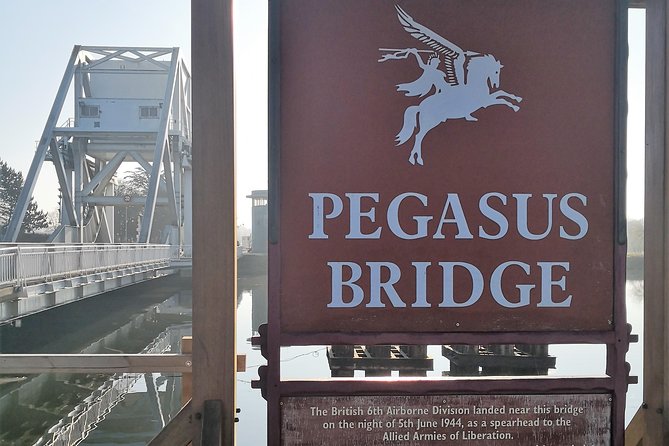
- Pegasus Bridge: British airborne objectives in the opening minutes of 6 June 1944, tied to the Caen Canal and the larger allied invasion plan
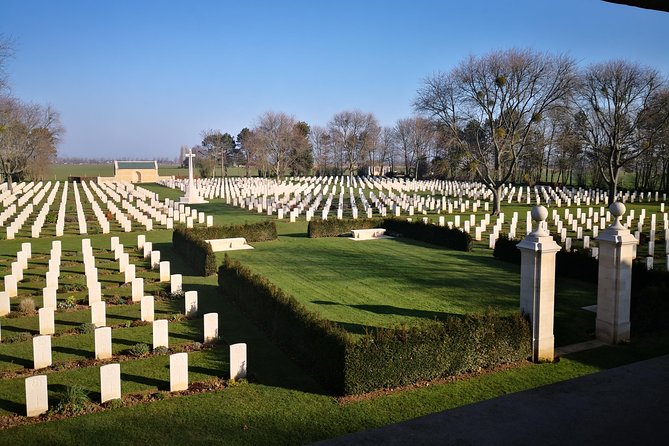
- Bény-sur-Mer Canadian War Cemetery: landscaped and carefully kept graves for predominantly Canadian soldiers from the early Battle of Normandy
- La Maison des Canadiens (Canada House): a wartime house linked to the first minutes and the human side of occupation and liberation
- Juno Beach Centre: permanent exhibits organized by themes and time periods, plus major film components
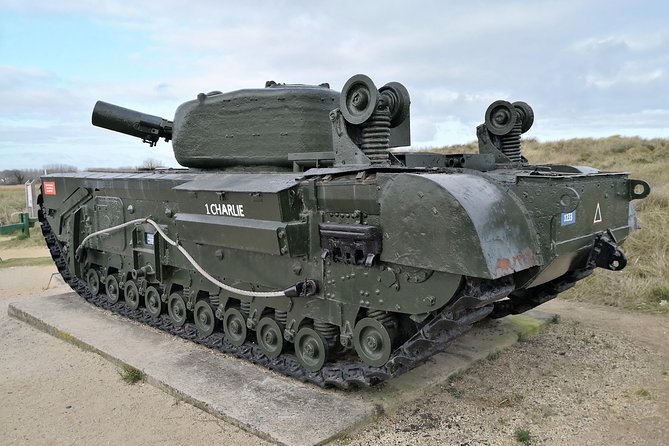
- Croix de Lorraine and Churchill AVRE Tank memorial: a de Gaulle monument and a vehicle memorial that explains the landing engineering reality
You can also read our reviews of more tours and experiences in Paris.



Pegasus Bridge: Where the First Hours Were Won or Lost
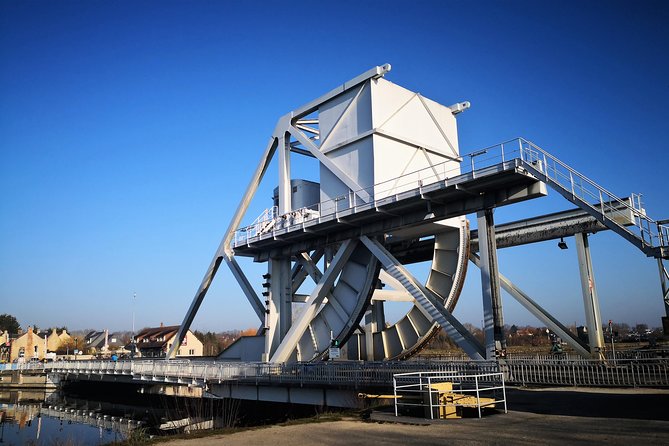
Pegasus Bridge is one of those sites that makes the whole D-Day operation feel immediate. This bascule bridge crosses the Caen Canal between Caen and Ouistreham, and it was built in 1934, decades before it became a strategic hinge point in 1944.
The Allied airborne mission here is central to why the bridge is famous. It was a major objective of British glider troops during Operation Deadstick, part of Operation Tonga, at the start of the invasion on 6 June 1944. The plan was straightforward but dangerous: land, take the bridges intact, and hold until relieved.
If you care about why places matter, Pegasus Bridge delivers. The guide context (and the way the stop is timed) helps you understand that holding the bridges limited the effectiveness of German counter-attacks in the days and weeks after the landings. That is not just trivia. It is how you connect one dramatic moment to the slower grind that followed.
Practical note: the stop is short, about 20 minutes, so if you want to read every detail on-site, show up mentally ready to absorb fast. This is a “set the stage” stop.
Bény-sur-Mer Canadian War Cemetery: A Place to See the Scale
Next comes the Bény-sur-Mer Canadian War Cemetery near Caen in lower Normandy. This cemetery is focused on Canadians killed in the early Battle of Normandy, and it is beautifully maintained in the way French war cemeteries often are, with a careful, respectful layout.
What I find most important here is not just the fact of sacrifice, but the scale you can actually sense. The cemetery contains 2,049 headstones. It also features the Cross of Sacrifice, an architectural memorial design connected to the Commonwealth War Graves Commission tradition.
Even the name is a detail worth noticing. Though it is called Bény-sur-Mer, it is near the village of Reviers. The local connection matters because the grounds are cared for with devotion by the nearby community, who feel the cemetery is part of their own story.
There is also a practical design element that helps visitors take it in: the entrance hedges, the flanking registry buildings, and platforms from which you can see the whole area. In other words, you are not left squinting at a partial view. The cemetery is planned so you can grasp the setting.
Expect about 30 minutes here. That is enough time to slow down, find a moment, and still keep the day on track.
La Maison des Canadiens (Canada House): When History Lives in a House
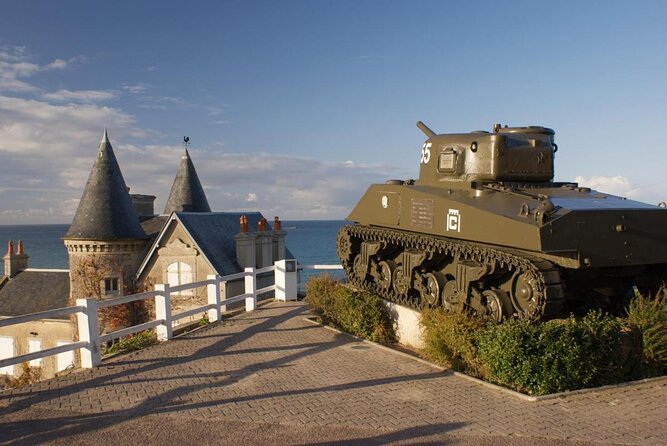
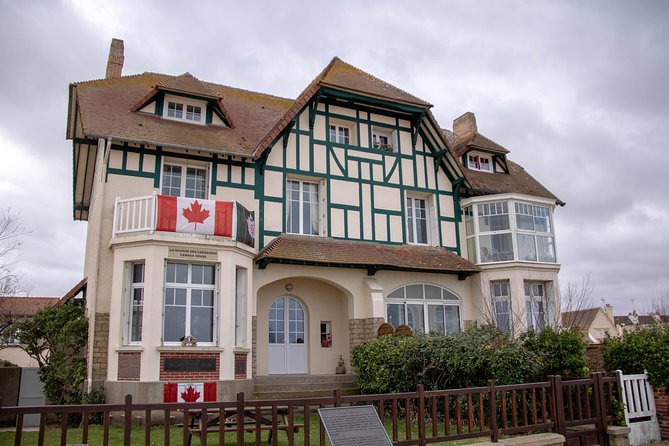
Then you get a very different kind of site: a timber-framed house overlooking Juno Beach in Bernières-sur-Mer. La Maison des Canadiens, often called Canada House, is iconic in Canadian military memory because it was one of the first houses liberated by Canadians on D-Day.
There is a stark inscription at the entrance about what happened within sight of the house. It sets the tone immediately, the kind of line that makes you stop walking and start paying attention.
This stop is special because it is not just a monument. It is a building with personal ownership history. The left-hand side is owned by the Hervé Hoffer family, and the story goes back to the war. The house was favored by an occupying German officer, which may explain why it was left intact, and the Hoffer grandfather was evicted by the Germans.
Another human detail: in 1984, on the 40th anniversary of D-Day, Hervé Hoffer met surviving Canadians who returned on pilgrimages. That kind of meeting, decades later, is exactly why sites like this matter. They are not only relics. They become bridges across time.
This stop is about 20 minutes. It is a quick visit, but it works well when you treat it as a pause between larger battlefield spaces.
Juno Beach Centre: Where the Story Becomes Understandable
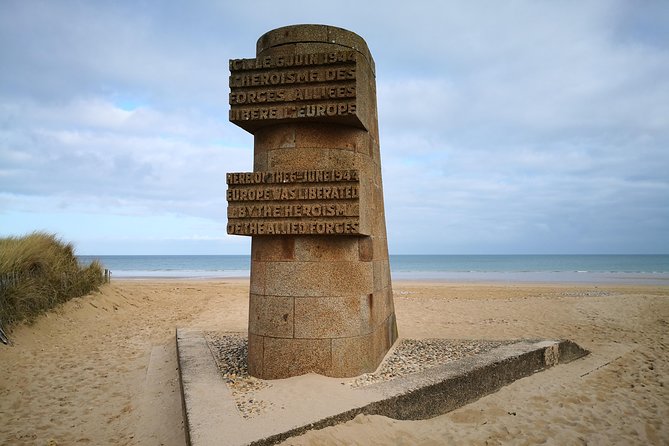
This is the heart of the day. Juno Beach Centre is included in the tour price, and you get about 2 hours inside. This is the part I would not skip if you are trying to understand what you are seeing out on the coast.
The permanent exhibit uses photographs, documents, multimedia, maps, and artifacts to tell the story of Canadians who volunteered or were mobilized at home to contribute to the war effort. It also connects the bigger timeline, showing Canadian battles from Sicily and Italy all the way through Normandy and into the Netherlands.
The museum also anchors its focus with numbers that help you understand the scale. It pays tribute to the 45,000 Canadians who lost their lives during the war, with 5,500 killed during the Battle of Normandy and 359 on D-Day.
What makes the exhibit feel more grounded is that it is organized into rooms with specific themes:




Room A: Courseulles, June 06th 1944
You start by stepping into a simulated landing craft to watch a film. It shifts you into the mindset of Canadians during the war moment, with images projected on walls and Canadian soldiers and their families sharing what they thought and felt.
Room B: Canada in the 1930’s
This room gives you the pre-war reference points. It covers geography, demographics, the economy, the military situation, politics, and social climate. There is also a “young public” circuit built around virtual characters Peter and Madeleine you can meet through terminals.
Room C: Canada goes to War
You follow the transformation of the country as war begins and the armed forces build. There is a simulated Canadian living room scene with speeches announced for key figures, and a corridor-style presentation that shows how the whole country was mobilized.
Room D: Road to Victory
This is where the exhibit maps out campaigns and themes. You learn about the Battle of Italy, Normandy, the Scheldt, Rhineland, and victory, plus supporting roles like medical corps, war correspondents, and engineers. It also keeps themes linked to Canadians on D-Day and Canadians behind enemy lines, including an element connected to the 1st Canadian Parachute Battalion.
Room E: Some Came Back, Others Did Not
This section keeps the human toll in view and pairs it with hope. Names scroll across the ceiling to remember the dead, while the story also acknowledges how many Canadians returned home afterward.
There are alcoves where you can listen to period letters or essays written by Canadians in English or French. You encounter Peter and Madeleine for the last time here, which is a clever way to keep younger visitors oriented without turning the rest of the exhibit into a kids-only track.
Room F: They Walk With You
The film uses powerful video and emotionally engaging audio, including voices from Canadian war correspondents Marcel Ouimet and Matthew Halton. It uses WWII newsreel footage and dramatic recreations to reenact the role and sacrifice of Canadian infantry soldiers during D-Day and the Battle of Normandy. Viewer discretion is advised.
For me, the value is that the museum does not just say what happened. It helps you understand what it felt like, and it places individual stories inside the larger military plan.
Croix de Lorraine and the Churchill AVRE Tank: Memorials With Mechanics
The last stop brings you to the Croix de Lorraine monument and a nearby Churchill AVRE Tank memorial.
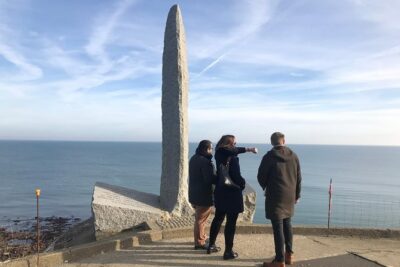
The Croix de Lorraine is a tall monument, more than 18 meters high, facing the sea. It commemorates General de Gaulle’s return to French soil on 14 June 1944 after crossing the English Channel on the French destroyer La combattante.
Then you are shown a Churchill AVRE tank, often referenced here as One Charlie. It stands as a memorial of landing operations on 6 June 1944. The tank was unable to bridge a deep culvert about 100 yards south of the site, and the crew had to escape under enemy fire, with heavy casualties.
This is a meaningful final stop because it reminds you that D-Day was not just bravery and landing craft. It was also engineering, timing, and obstacles that did not care about intentions.
Expect around 30 minutes here. This is enough time to read the key context and take in the monument and tank without turning the final leg into a second museum.
Price and Value: What You’re Paying For at $288.99
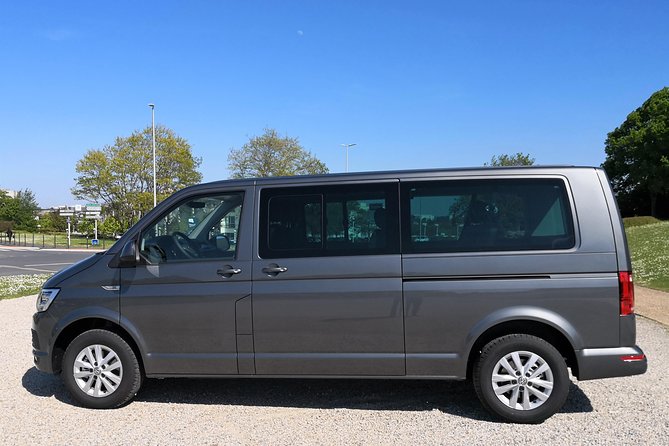
The price is $288.99 per person, and it includes transportation by air-conditioned vehicle, a guide, and entry to Juno Beach Centre.
A big part of the value is the time cost. A DIY day from Paris to hit multiple sites like Pegasus Bridge, a Canadian cemetery, Canada House, and then Juno Beach Centre means you are doing a lot of driving and scheduling. When you add a guide who can explain why these specific spots connect, the package starts to make sense.
Also, not every stop charges you. The itinerary lists free admission for Pegasus Bridge, the cemetery, La Maison des Canadiens, and Croix de Lorraine. Juno Beach Centre is the paid inclusion at admission level, and you get that 2-hour window inside.
So your money is really buying: early transportation, guide interpretation, and museum time that you might otherwise rush past. If you only want beach photos, it may feel steep. If you want the Canadian WWII story told in an organized way, it can feel like a fair trade.
If you do book, plan around what is not included: lunch and drinks are not part of the price unless specified. For a 13 to 14 hour day, bring the mindset that you need food planning.
Who This Tour Fits Best (And Who Should Rethink It)
This tour fits you best if you:
- want a focused Canadian WWII route from Paris without renting a car
- like small groups and want your questions answered in real time
- care about meaning behind the sites, especially through the Juno Beach Centre permanent exhibits and film
It might be a tough fit if you:
- dislike early starts, since the start time is 6:30 am
- prefer a slower pace or extra time at each stop, since the day runs 13 to 14 hours and includes short visits plus one longer museum block
- need a fully meal-inclusive day, since lunch food and drinks are not included
One more small point: the tour is offered in English, and you get confirmation at booking time.
Should You Book This Canadian D-Day Tour From Paris?
Yes, if you want the core Canadian D-Day experience in one long day, guided and structured, with Juno Beach Centre at the center of it. The combination of Pegasus Bridge context, the Canadian cemetery scale, the human story of La Maison des Canadiens, and the exhibit planning inside the museum makes the visit feel connected rather than random.
If you have limited time in Paris and your goal is Juno Beach with proper context, this is a strong choice. If you want a leisurely Normany coast day or a lunch-inclusive package, you might feel the constraints more.
FAQ
How long is the Normandy tour from Paris?
It runs about 13 to 14 hours.
What time does the tour start, and where is the meeting point?
The start time is 6:30 am, and the meeting point is Théâtre du Lido, 116 bis Av. des Champs-Élysées, 75008 Paris, France. The tour ends back at the same meeting point.
Is the tour offered in English?
Yes, it is offered in English.
What is included in the price?
The price includes air-conditioned transportation, the guide, and entry to Juno Beach Centre. Juno Beach Centre admission is listed as included.
What is not included?
Lunch and food and drinks are not included unless specified.
How large is the group?
The tour has a maximum of 7 travelers.
Do I need an admission ticket for Juno Beach Centre?
Yes, Juno Beach Centre entry is included in the tour, so you should not need to purchase admission separately for that stop.
Can I cancel for a full refund?
Yes. You can cancel up to 24 hours in advance for a full refund.
What happens if the tour is canceled due to weather or minimum travelers?
The tour requires good weather. If it is canceled due to poor weather, you will be offered a different date or a full refund. It can also be canceled if the minimum number of travelers is not met, with a different date or a full refund offered.
More Tour Reviews in Paris
Not for you? Here's more nearby things to do in Paris we have reviewed












Normandy Day Trips, side by side.
 ★ 5.0Normandy D-Day Sites & Cemetery Day Trip from Paris with LunchTickets from $1206,877 guest reviews
 ★ 5.0Normandy D-Day Small-Group Day Trip with Omaha Beach, Cemetery & Cider TastingTickets from $3202,786 guest reviews
 ★ 4.5Normandy D-Day Beaches and American Cemetery Day Trip from ParisTickets from $2072,673 guest reviews
 ★ 4.7Normandy D-Day Sites Guided Day Trip with LunchTickets from $1171,082 guest reviews
 ★ 4.8From Paris: Normandy D-Day Landing Beaches Full-Day TourTickets from $312698 guest reviews
 ★ 4.6From Paris: Normandy D-Day Beaches Day TripTickets from $199566 guest reviews
 ★ 5.0Normandy D-Day Beaches with Juno Beach, bunkers & Canadian Cemetery from ParisTickets from $290296 guest reviews
 ★ 5.0Normandy D-Day Landing Beaches Small-Group Day Trip from ParisTickets from $344275 guest reviews
This tour also belongs to