
Review · PARIS CITY TOURS
WW1 Australian Battlefield Day Tour from PARIS: Somme, Villers-Bretonneux…
Australian WW1 sites hit differently. This private day tour takes you to key moments where Australians fought and where the missing were remembered, with an expert WW1 guide in a small group. I love how the stops are thoughtfully spaced, so you actually have time to look and ask questions, and I love that it is private transportation with a maximum of 7 passengers. One thing to consider is that it is a long 9 to 11 hour day away from Paris, so plan for a full day of walking on uneven ground at memorial sites.
If you are Australian, you will feel the emotional weight more, but even if you are not, the day is built around the big realities of 1916 to 1918, from a mine crater to trench lines to name lists. On top of the battlefield sites, you end at the Australian National Memorial and the Sir John Monash Centre, where the story is tied together in a way that makes the geography easier to understand. The main drawback for some people is the subject matter, it is solemn, and you should come ready for that.
Key highlights worth planning for
- Small private group (max 7) keeps the pace human and your guide available for questions
- Lochnagar mine crater gives you a rare, physical sense of what that July 1, 1916 explosion did
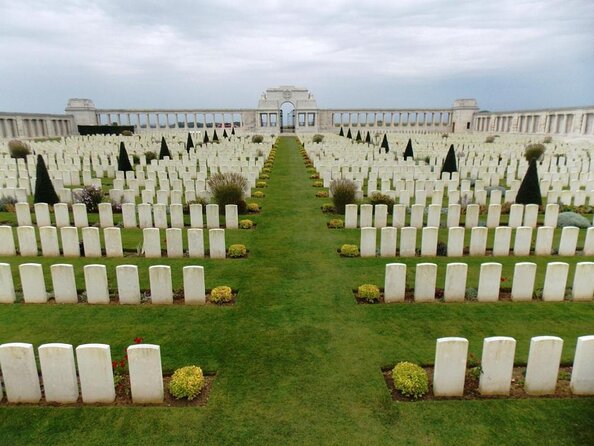
- Thiepval memorial focuses on the missing, with a stop designed for reflection
- Beaumont-Hamel Terre-Neuvien trenches preserved lets you see original lines rather than just photos
- Villers-Bretonneux Australian National Memorial honors about 11,000 missing Australians in France
- Sir John Monash Centre adds context with a dedicated, story-led experience
A straight shot from Paris, built for a long WW1 day
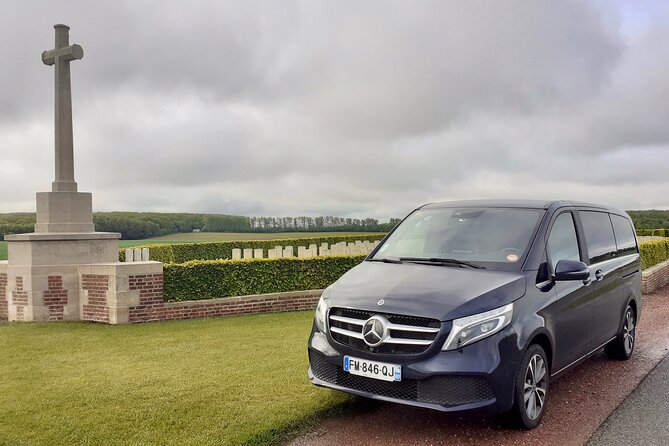
This is one of those day trips that works because it removes the hardest part, getting across the Somme region efficiently. A professional driver and WW1 expert guide handle the route in an air-conditioned vehicle, and you do not need to figure out connections between scattered memorials and battlefield sites.
Expect a long day. The tour runs about 9 to 11 hours, with short site stops and a couple of slightly longer moments, including an hour at Beaumont-Hamel and time for lunch in Albert. You will want to wear comfortable shoes and keep your layers handy, because the weather on the Western Front can shift.
You can also read our reviews of more tours and experiences in Paris.



Private pickup and the small-group advantage
The biggest practical win here is that it is a private tour for your group only, with a stated maximum of 7 passengers. That matters on battlefield days. You are not stuck watching through a crowd while everyone streams back to the bus at the same time.
Pickup is offered, and there is a mobile ticket, which keeps the start smoother. Also, service animals are allowed, and the tour says most travelers can participate, which is helpful if you are trying to decide quickly without a lot of extra research.
If you are the kind of person who likes to ask one more question after a stop, a small group usually pays off fast.
Lochnagar Crater, the mine blast you can see
Your day starts at Lochnagar Crater, the huge mine crater created by an underground mine blown on July 1, 1916. Even with just 30 minutes, this stop does something important: it turns trench-era history from text into scale. It is the kind of site where you find yourself looking at angles, edges, and what the explosion physically did to the ground.
The time here is short, so use it well. If you want to understand what you are looking at, ask your guide what the crater location meant for the surrounding attacks and why that date matters. The goal is not to rush through. The goal is to leave this stop with a mental picture you can use for the rest of the day.
The first Australian Division memorials, and the cost of holding ground
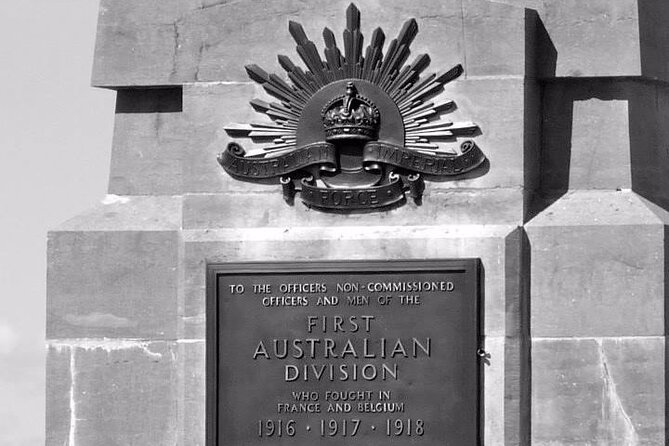
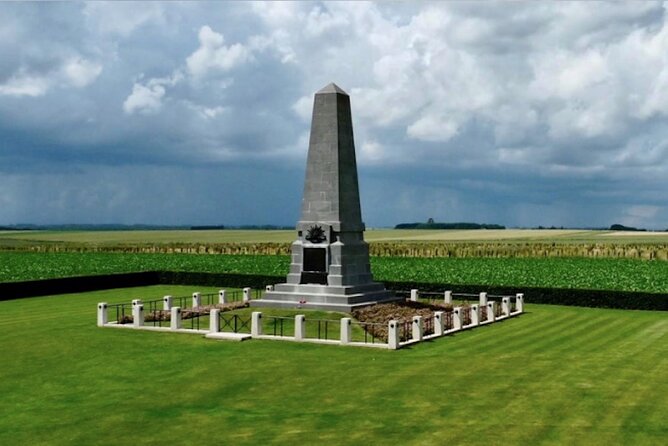
Next up is a set of sites linked to the 1st Australian Division memorial area, including the Gibraltar bunker, the Windmill, and Mouquet farm. This is where the day becomes less about one dramatic moment and more about the grind of holding positions and losing them.
You get about 30 minutes here, which is tight but workable if your guide is good at pointing you to what to notice. The practical value of this stop is that it helps you understand why memorials cluster in the Somme region. Australians were not fighting in one single place, they were fighting across linked sectors, and these names give you a map.
One possible drawback is that 30 minutes can feel fast when the topic is heavy. If you tend to slow down when emotions hit, you may want to mentally prepare that the pace is part of how the tour fits all the major stops into one day.
Thiepval Memorial, where the missing are the focus
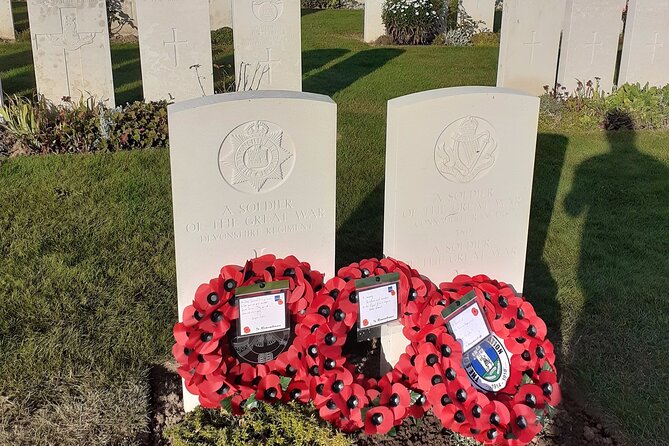
Thiepval is a memorial to the missing of the Somme, and it is designed around names and absence. You have about 30 minutes, which is enough time to do two things: read what you can, and then step back to take in the overall meaning of the site.
This stop is powerful because it reframes the battle. You are not only dealing with what happened on specific dates, you are dealing with what could not be recovered. A WW1 memorial like this also gives you context for later sites, especially the Villers-Bretonneux memorial, where the idea of remembrance by name becomes even more concrete.
If you want to get the most from Thiepval, bring the mindset of a careful reader, not a quick tourist. Even skimming thoughtfully can make the site land.





Beaumont-Hamel (Terre-Neuvien) trench lines, original ground
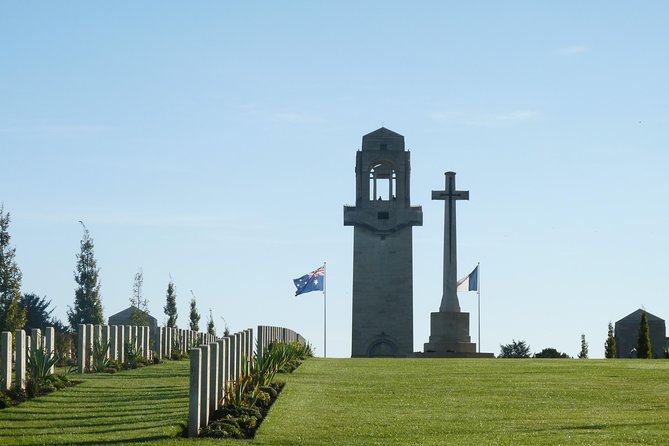
One of the best stops on this day is the Terre-Neuvien de Beaumont-Hamel area, where the battlefield is preserved with original trenches from the 1916 battle of the Somme. You get about 1 hour here, which is meaningful, because trench sites are not just photo opportunities. They require time for your eyes to adjust.
In practical terms, this is where the Somme geography clicks. Standing near preserved trenches helps you understand how small changes in elevation and distance mattered, and why movements that look short on paper were enormous in reality. Your guide can connect the trench lines to the broader Australian role, and that makes the day feel less like separate stops and more like one story.
A consideration: trench memorial sites can involve uneven ground and paths. You do not need hiking gear, but you do need grip and patience.
Lunch in Albert, and a quick reset in a real town
You get about 50 minutes for lunch in Albert, with time to enjoy the town and its famous basilica. This is a good pause, especially after long moments of reading and reflection.
Because lunch is not included, you will need to decide what works for you in that window. If you tend to get hungry quickly, consider planning a simple meal nearby so you are not hunting while the clock ticks. If you are sensitive to the subject, this lunch break can be mentally useful too. It gives you a moment to reset your energy before the emotional finale.
The Australian National Memorial at Villers-Bretonneux
Villers-Bretonneux is where the day turns from battlefront geography to remembrance at scale. You visit the Australian National Memorial, which commemorates about 11,000 Australians missing in France in World War One. It is described as the largest Australian memorial in Europe, and that size matters because it signals how many lives are represented here.
You have about 40 minutes for this stop, which is enough to do more than look. If your family has a connection, this is where you may find names and feel a direct, personal connection to the story. In the past, people have shared meaningful moments in this exact setting, like locating a relative’s great uncle on the memorial. You do not need to have Australian roots to find it moving, but it tends to hit harder when you do.
One practical tip: scan with intention. If you try to read everything at once, the memorial can feel overwhelming. Instead, aim for what you came to find, then take in the overall effect.
Sir John Monash Centre, context after the names
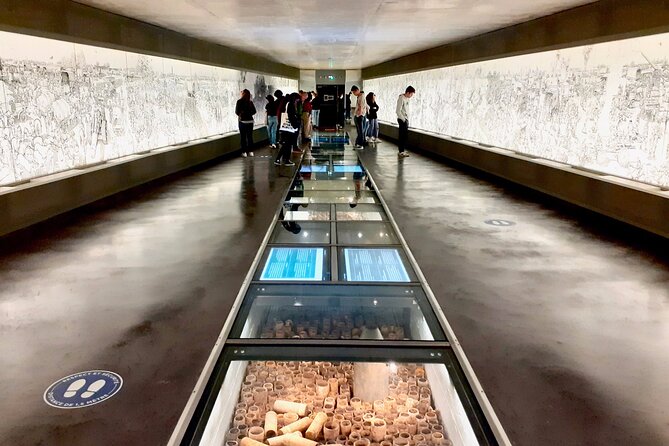
After Villers-Bretonneux, you go to the Sir John Monash Centre, with about 45 minutes on site. This centre is built to help you understand the Western Front story, and it includes an interactive room experience that ties the battles together in a more interpretive way than memorial stone alone.
This is a smart final step in a day like this. The battlefield stops and memorial stops give you names, locations, and emotion. The Monash Centre helps you translate that into bigger understanding, so you leave with a clearer sense of how the Somme years connect to what happens in 1918.
If you are thinking, what do I do with everything I just saw, this is the answer. Use the time to ask your guide what the key takeaways are, especially how Australian actions fit into the broader momentum of the war.
Price and value: is $296 a fair deal for the day?
At $296 for the day, this is not a budget bus tour. But the price makes more sense when you break down what is included.
You get driver and WW1 expert guide, air-conditioned vehicle, private transportation, plus access to the sites and museum fees. That combination matters because the Somme region is spread out, and you are visiting multiple key locations that are not easy to string together neatly on your own in one day.
The value also comes from how the stops are structured. You are not spending hours in transit without context, and the time at each major site is built around quick learning plus reflection. Lunch and snacks are not included, so you will add that cost yourself, but that is common on long day tours.
If your goal is a respectful, guided route through Australian-related WW1 sites, this is the kind of day where the guide quality can make the biggest difference, and the small-group format helps that.
Who should book, and who might want a different format
This tour is a great fit if you want a focused WW1 Australian day without the stress of planning multiple stops. If you like order, clear explanations, and you want to see both battlefield sites and remembrance sites in one sweep, this hits the mark.
It also makes sense if you are visiting from Paris with limited time. The Somme can swallow whole weekends if you try to do it independently. A day trip like this keeps your schedule intact while still giving you the core places that shape the Australian story in the region.
You might consider another option if you dislike long days of solemn history or if you struggle with reading and reflection. The tour is built for remembrance and understanding, not for casual sightseeing.
Should you book this Australian WW1 battlefield tour from Paris?
I would book this if you want a guided day that balances geography, names, and context, with a guide who can explain what you are seeing in plain language. The combination of battlefield sites, Thiepval, Villers-Bretonneux, and the Sir John Monash Centre gives you both the emotional and the historical sides of the story in one route.
The decision comes down to your comfort level with a long, heavy day. If you are okay with that, you will likely come away with a clearer sense of what Australians faced on the Western Front, and why the memorials in this region are so specific.
FAQ
How long is the WW1 Australian Battlefield Day Tour from Paris?
The tour runs about 9 to 11 hours.
Is pickup offered for this tour?
Yes, pickup is offered.
Is this a private tour, and how many people are in the group?
It is a private tour/activity, and the group size is maximum 7 passengers, your group only.
What is included in the $296 price?
The price includes access to all sites and museum fees, a driver/guide who is a WW1 expert, an air-conditioned vehicle, and private transportation.
Is lunch included?
No, lunch and snacks are not included. There is a lunch stop in Albert.
Which major sites are visited during the day?
You visit Lochnagar Crater, the 1st Australian Division memorial area, Memorial de Thiepval, Memorial Terre-Neuvien de Beaumont-Hamel, Albert for lunch, the Australian National Memorial at Villers-Bretonneux, and the Sir John Monash Centre.
What if the weather is poor, or I need to cancel?
The tour requires good weather. If it is canceled due to poor weather, you will be offered a different date or a full refund. You can cancel for free up to 24 hours in advance for a full refund.
More Tours in Paris





More Tour Reviews in Paris
Not for you? Here's more nearby things to do in Paris we have reviewed











Paris City Tours, side by side.
 ★ 4.6Louvre Museum Timed-Entrance TicketTickets from $2671,977 guest reviews
 ★ 4.6Disneyland® Paris 1-Day TicketTickets from $6149,412 guest reviews
 ★ 4.6Versailles Palace and Gardens Full Access TicketTickets from $1741,579 guest reviews
 ★ 4.6Arc de Triomphe Rooftop TicketsTickets from $1834,264 guest reviews
 ★ 4.7Orsay Museum Entry TicketTickets from $1525,647 guest reviews
 ★ 4.4Evening River Cruise with MusicTickets from $2722,721 guest reviews
 ★ 4.4Eiffel Tower Entry Ticket with Optional Summit AccessTickets from $2920,035 guest reviews
 ★ 4.3Eiffel Tower Summit or Second Floor AccessTickets from $5917,248 guest reviews