
Review · SEINE RIVER CRUISES
Paris World Fairs Walking Tour Top Sights Along the Seine River
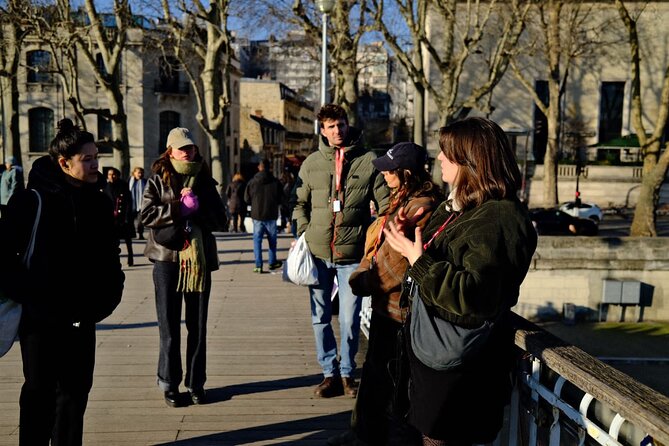
A walk with a world-fair secret. This 2-hour tour connects Paris landmarks to the big international exhibitions that shaped the city from the late 1800s into the early 1900s, with storytelling that links the river, the bridges, and the buildings into one clear theme. You’ll walk at an easy pace, stop often for photos, and hear how the Seine became the city’s main stage for progress and ideas.
What I like most is the small group size (up to 15), which makes it easier to ask questions and get answers that fit what you’re seeing. I also love how the route focuses on photo-friendly spots along the Seine without forcing you into long museum lines, so you still get the big Paris moments in a short time.
One consideration: it is a walking tour, so if you’re sensitive to standing and moving for about 2 hours, plan your footwear carefully and go easy on the pace at the start.
Key things I’d watch for
- World-Fair to World-Fair storytelling, with dates and connections that make the city feel logical, not random
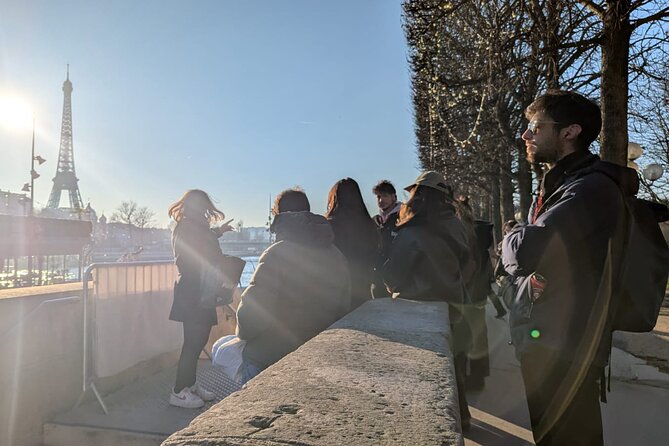
- Small group of 15 max, so your questions land with the guide and you are not lost in a crowd
- Plenty of free stops, many marked free to visit, so the sights feel like value, not extra spending
- Ornate bridges and river viewpoints, especially Pont Alexandre III and the path toward Trocadéro
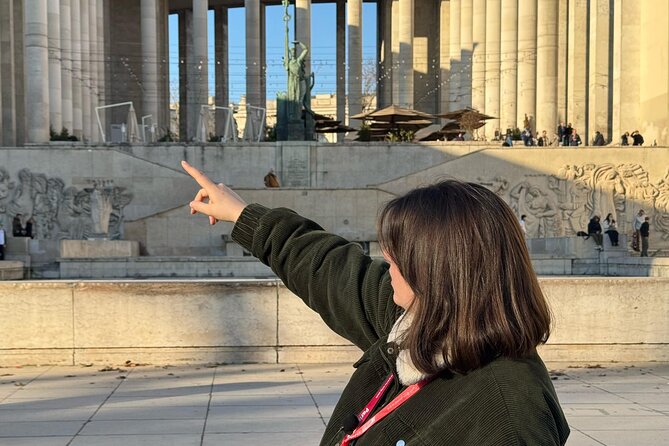
- Contemporary art stops (Palais de Tokyo and Palais de Chaillot), so the tour reaches beyond just classic monuments
Why this Seine walking route feels smarter than a standard highlights tour
Paris can feel like a collection of famous photos if you move too fast. This walk makes it click by treating the Seine River as the connecting thread. The river mattered for the World’s Fairs because it tied together exhibition sites and turned Paris into a showcase for architecture, technology, and art.
That theme also changes how you see the landmarks. Instead of only asking what a building looks like, you start asking what problem it solved in its time, who it was built to impress, and how it influenced what came next. The guide’s job is to put the pieces together as you move from one “pause for a view” to the next.
You also get the practical upside of a short experience. At roughly 2 hours, you can fit it into a busy day without spending half your vacation inside venues. And since the route is packed with recognizable, free-to-view exteriors, you end up with a set of memorable images even if you are not planning a museum day.
You can also read our reviews of more walking tours in Paris

Starting at Champs-Elysées and the 1900 Exposition transport story
The tour begins at Statue du Général Charles de Gaulle, Pl. Clemenceau in the 8th arrondissement. This is a convenient launch spot because it sits near major transit lines, so you are not stuck with a long taxi bill or a complicated last walk.
The first stop is the Champs-Élysées – Clemenceau metro station (Line 1). It opened for the 1900 Paris Exposition Universelle, and that detail matters because it reframes the station as part of the city’s World-Fair momentum, not just daily commuter infrastructure. Standing there, you get a useful reminder that “modern” in 1900 meant new transport, new design, and a faster way to move crowds.
You’ll also be positioned close to a concentration of beautiful architecture, including the Grand Palais and Petit Palais. That matters for your time and energy. The walk compresses a lot into a short radius, so you get multiple iconic stops with minimal transit-between-scenes stress.
Grand Palais: when industry, art, and the glass dome meet
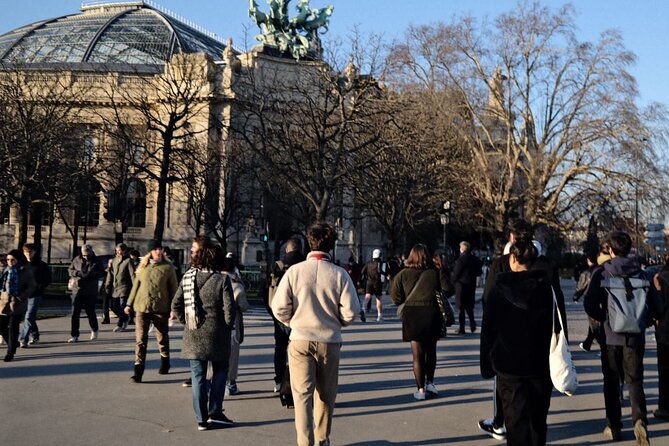
Next up is the Grand Palais, built for the 1900 Exposition Universelle. It’s the kind of building you recognize instantly in photos, largely because of that famous glass-domed roof. But the more interesting part is how the building blends industrial and classical design.
For you, that means the guide’s explanations can help you read the architecture. Paris didn’t only build monuments for beauty. It also built spaces to host events and show off ideas, from major art exhibitions to fashion shows and cultural events. That hybrid purpose is exactly what made it useful during the World’s Fair era.
The stop is short, so don’t expect a full deep museum visit. Instead, think of it as a chance to get oriented and then move. If you’re the type who likes a quick “place in context” moment before you explore more on your own, this format works well.
Petit Palais and its quieter courtyard energy
The Petit Palais follows, also built for the 1900 Exposition Universelle, and now home to the Musée des Beaux-Arts de la Ville de Paris. Even if you do not go inside, it’s worth the stop for the grand setting and the calm courtyard vibe.
What you get here is a nice balance to the larger Grand Palais. The Petit Palais route points your attention toward art spanning antiquity to the early 20th century, and it also highlights the building’s frescoes and architectural details. It’s a good reminder that World’s Fairs were not only about big engineering statements. They were also about culture, taste, and placing France in the international art conversation.
Again, timing is brief. If you want more time inside the museum, you might save that for another day. But for a 2-hour theme walk, the exterior and immediate experience does the job.
Pont Alexandre III: ornate Franco-Russian symbolism and city views
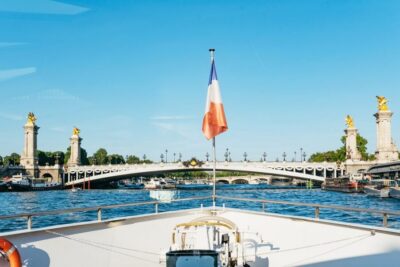
Once you’re near the bridges, the tour shifts into big-picture sightlines. Pont Alexandre III is one of the most ornate bridges in Paris, and it was built for the 1900 Exposition Universelle.
The guide’s connection to Franco-Russian ties gives you a reason to look closer. You can see gilded sculptures, intricate ironwork, and Art Nouveau lamps, and suddenly the bridge becomes more than an obstacle you cross. It becomes a statement that Paris could stage international relationships in public space.
This stop also pays off for photos. You get classic river angles and a framing that includes major buildings. If you like getting pictures that look like Paris postcards but still feel earned, this is a strong point to slow down for a moment.
The Seine as a World-Fair highway, plus Bateaux Mouches origins
Between bridge stops, the story broadens. The Seine River is described as a key backdrop for World’s Fairs from the late 1800s into the early 1900s, where grand exhibitions showcased architectural marvels, technological innovation, and artistic breakthroughs. The river’s role was practical too, since it connected sites and helped Paris look like it was built for modern exchange.
The tour also includes a detail that makes a modern Paris habit feel historical: the Bateaux Mouches began as visitor transport for the 1867 Exposition Universelle. Today it’s a sightseeing name you’ll recognize easily, but the origin story is the kind of fact that changes how you see what you already know.
Even if you are not taking a boat during this walk, that context makes the river feel busy with legacy. It also helps you understand why the bridges and embankments are not just scenery, they are part of the city’s World-Fair infrastructure.
Pont de l’Alma, the Liberty Flame, and the 1855 link to earlier fairs
The tour then moves toward the Pont de l’Alma area. Pont de l’Alma was built for the 1855 Exposition Universelle. While it has been rebuilt, it retains the Zouave statue, which originally served as a flood gauge. That’s a fascinating kind of detail because it turns a decorative moment into a practical urban tool.
Near that area is the Flamme de la Liberté, a full-scale replica of the Statue of Liberty’s flame. The guide connects its origin to the 1878 Exposition Universelle, when the Statue of Liberty was first showcased before its journey to New York. The tour also notes that the flame was donated by the International Herald Tribune in 1989, and later it became an unofficial memorial to Princess Diana.
For your experience, this stop is more than a photo moment. It shows how World-Fair objects and symbols can outlive their original purpose and become local meaning over time. It’s also a helpful reminder that international events often leave behind artifacts, not only memories.
Passerelle Debilly and why a footbridge fits the World-Fair story
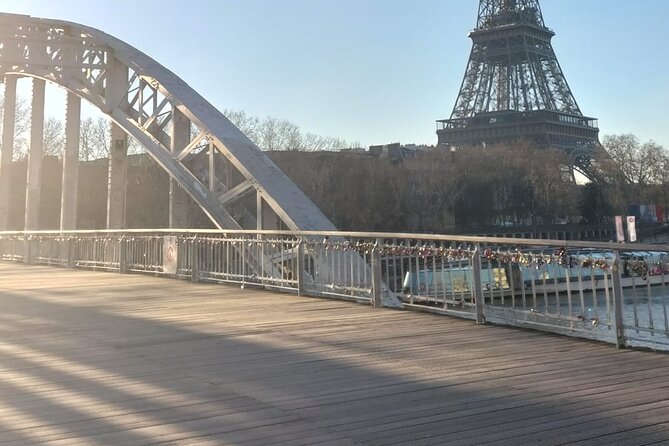
Next you reach the Passerelle Debilly. This footbridge was built for the 1900 Exposition Universelle and spans about 120 meters over the Seine.
Even if you do not study bridges for fun, this one works because it’s human scale. The guide links it to the World-Fair goal of moving visitors between points on the riverfront, including the idea of connecting the Quai Branly to Avenue de New York. When you see it after the ornate architecture, it provides variety in how the city solved crowd movement.
If you like thoughtful design, you’ll probably enjoy the contrast between the fancy showpiece bridge (Pont Alexandre III) and this practical connector bridge.
Palais de Tokyo and Palais de Chaillot: modern art housed in fair-built architecture
After the river crossings and viewpoints, the tour shifts to contemporary art buildings that still have fair-built DNA.
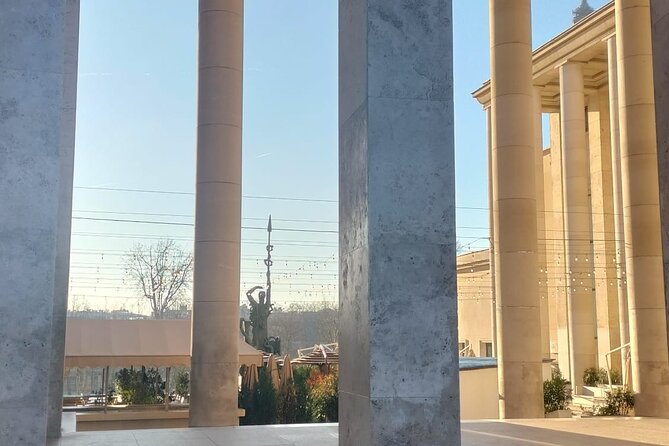
Palais de Tokyo was inaugurated in 1937 for the Exposition Universelle. Today it’s described as Europe’s largest center for contemporary art. This matters for the tour theme because it shows Paris didn’t stop updating its identity after the 1900s. It kept reusing and repurposing grand event spaces.
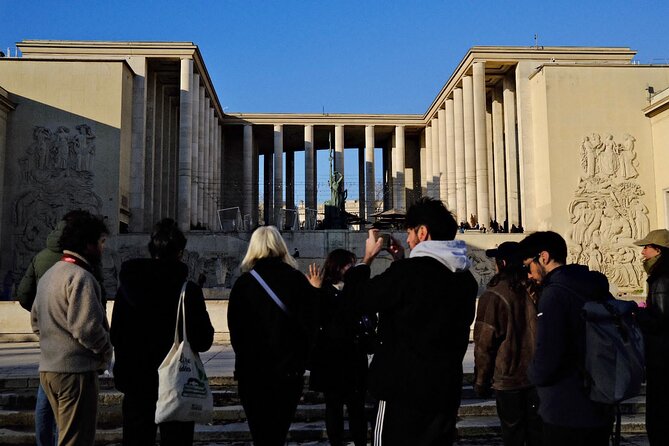
Then comes Palais de Chaillot, built for the 1937 International Exposition. The tour notes the architects (Léon Azéma, Jacques Carlu, and Louis-Hippolyte Boileau). It also explains that Palais de Tokyo and Palais de Chaillot were part of a group of three structures intended to last beyond the event.
You might not have time for a full art gallery visit on a walking tour, but the context changes what you notice from outside. You start seeing these buildings as long-term city planning, not temporary fair props. For people who like culture but do not want to commit to a museum schedule, this is a smart middle ground.
Trocadéro fountain, Pont d’Iéna, and the Eiffel Tower finale
The final stretch brings you toward some of the most famous views in Paris. The tour includes the Trocadéro Fountain, built in 1937 and connected to the 1878 Exposition Universelle replacement story. It’s also tied to Eiffel Tower sightlines, since the fountain sits in a viewpoint area that naturally frames the tower.
Then you walk through the story of Pont d’Iéna, described as playing a role in multiple Expositions Universelles in Paris: 1867, 1878, 1889, and 1900. The bridge’s roots go back to a commission by Napoleon I, and the guide also points out that it is in the spotlight again as part of Paris 2024 Olympic Games ceremonies and events.
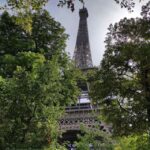
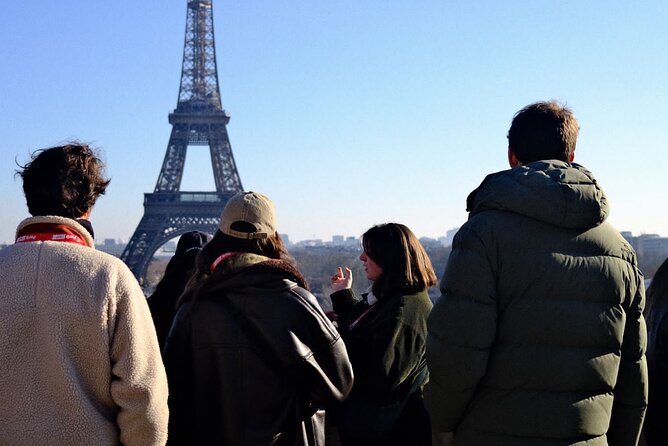
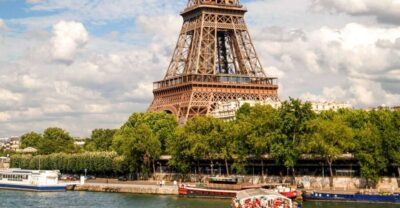
Finally, you end at the Eiffel Tower. The tower was built for the 1889 Exposition Universelle, originally faced with criticism, then became Paris’s icon. The tour frames the Eiffel Tower as a symbol of engineering progress, and it links back to the theme of international events shaping the city’s identity. That’s a satisfying way to close, because you get the big landmark, but you do not treat it as a random stop. You treat it as the payoff of the World-Fair storyline.
The tour also states the end location as Tour Eiffel, 5 Av. Anatole France, so you finish right where you can either keep exploring or switch to your next plan.
Pace, photo strategy, and what to bring
This is a walking tour of about 2 hours, with short stops that keep moving. That helps you cover more without feeling stuck, but it also means you should use the photo moments efficiently.
Here’s how I’d handle it:
- Bring a camera or phone with enough storage, because bridges and viewpoints are where you’ll want extra shots.
- Wear comfortable shoes, since you’ll be on your feet for most of the experience.
- If you have limited time in Paris, this walk is ideal as a “first context” tour so your later explorations make more sense.
The guide’s style seems to be a major factor in satisfaction. Several comments highlight clear explanations, an enthusiastic tone, and a guide who keeps the info at the right level. One guide named Olivia is specifically praised as fun and passionate, with anecdotes that make the World’s Fair details feel human instead of like a textbook.
Price and value for a 2-hour, small-group theme walk
The price is $43.26 per person. For a Paris tour, that is not just about getting from point A to point B. You are paying for a local guide who ties together multiple time periods and explains what you are seeing in real time.
What makes the value feel better here is the combination of:
- A small group capped at 15
- A route with many free to visit stops (the sights listed show admission ticket free)
- A tight theme that helps you interpret the city instead of only collecting photos
Also, since the tour lists no food and drinks and no transport to and from the meeting point, you can keep your costs predictable. You’re basically paying for guidance and the structure that turns a scenic walk into a coherent story.
Who should book this, and who might skip it
I’d recommend this tour if you want:
- A history angle that connects directly to what you see outside
- A short activity that still feels thoughtful
- A route along the Seine that hits major landmarks without making you wait in long lines
I’d consider skipping if you want a deep museum session or a long guided interior visit. This tour is built around short stops and context, not full ticketed attractions.
It also fits well for first-time visitors and returning visitors who want a new lens. One person even described it as changing how they saw their neighborhood, which is exactly what this kind of “see the theme, not just the buildings” tour can do.
Should you book the Paris World Fairs Seine walk?
If you have two hours and you like Paris stories that connect architecture to real events, yes, book it. This is a strong choice when you want a guided thread through big landmarks, especially if you plan to spend the rest of your trip exploring on your own.
If you are the type who gets bored by dates, you might worry. But the tour is designed to make those dates matter, like the way the 1855, 1867, 1878, 1889, and 1900 dates show up across bridges, fountains, and landmarks. You’re not just hearing trivia. You’re learning how the city became the city you recognize.
Go for it when you want both the views and the “why this looks like this” answers.
FAQ
How long is the tour?
The tour lasts about 2 hours.
How much does it cost?
It costs $43.26 per person.
What language is the tour offered in?
The tour is offered in English.
How big is the group?
The tour has a maximum of 15 travelers.
Where does the tour start and end?
It starts at Statue du Général Charles de Gaulle, Pl. Clemenceau, 75008 Paris, France, and ends at Tour Eiffel, 5 Av. Anatole France, 75007 Paris, France.
Are admissions included?
The tour lists admission ticket free for the sights included on the route.
What is not included in the price?
Food and drinks, and transport to/from the meeting point are not included.
More Walking Tours in Paris
More Tours in Paris

More Tour Reviews in Paris

Not for you? Here's more nearby things to do in Paris we have reviewed








Seine River Cruises, side by side.
 ★ 4.4Evening River Cruise with MusicTickets from $2722,721 guest reviews
 ★ 4.3Illuminations River Cruise with Audio CommentaryTickets from $2012,340 guest reviews
 ★ 4.3Tootbus Hop-on Hop-off with optional river cruiseTickets from $4911,924 guest reviews
 ★ 4.4Seine Cruise & Crepe Tasting near the Eiffel TowerTickets from $2311,231 guest reviews
 ★ 4.3Seine River Panoramic Views Dinner CruiseTickets from $6410,611 guest reviews
 ★ 4.6Louvre Museum Entry Ticket With Host and River CruiseTickets from $1009,926 guest reviews
 ★ 4.6Eiffel Tower Access by Elevator & Seine River CruiseTickets from $797,329 guest reviews
 ★ 4.73-Course-Dinner Cruise on the Seine with live musicTickets from $1357,248 guest reviews
This tour also belongs to