

Review · PARIS CITY TOURS
WW1 Somme Battlefield – Thiepval, Beaumont Hamel – Day trip from Paris (3/7 pax)
The Somme starts before sunrise in Paris. I love the small-group pace (max eight) and the included focus on Thiepval Memorial and the Historial museum. The trade-off is a long day, roughly 12 to 13 hours, with limited time at each site.
I especially liked the way the tour is guided. With a driver guide, and the guide Regis specifically praised for being a strong local historian, you get context fast, not just stop-and-stare facts. The tour runs in English and uses an air-conditioned vehicle, so the morning commute is easier than you might expect.
You’ll hit key WW1 locations tied to the Battle of the Somme: Lochnagar Crater, Thiepval, Ulster positions, and Beaumont-Hamel’s Newfoundland memorial park. Most of the outdoor memorial sites are free to enter, which helps keep the day focused on walking, reading, and absorbing what you’re seeing.
Key highlights that matter on the ground
- Lochnagar Crater at La Boisselle explains the opening-day mine operation with concrete details like depth, distance, and explosive weight
- Thiepval Memorial to the Missing places you at the scale of the tragedy, with more than 72,000 names for UK and Commonwealth soldiers
- Historial de la Grande Guerre includes entry and features Joe Sacco’s 60-metre panoramic mural
- Ulster Memorial Tower sits on the German front line tied to the Schwaben Redoubt and the Ulster Division’s capture
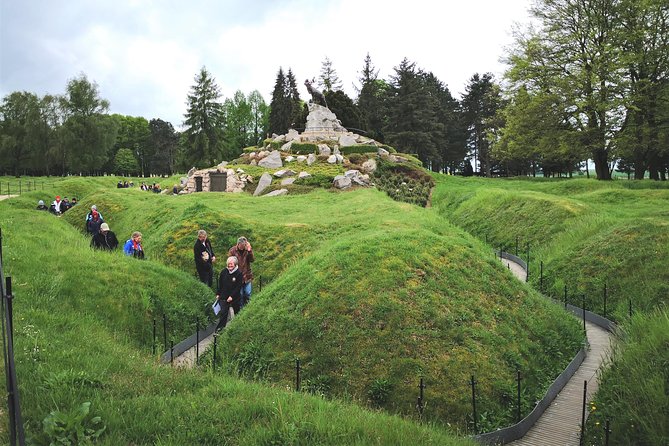
- Beaumont-Hamel Newfoundland Memorial Park preserves trench networks and marks the Newfoundland Regiment’s attack on July 1, 1916
- Small-group touring (max eight) keeps the pace human, and makes questions easier to answer
A long morning from Paris, and why 6:30 am is worth it
This day trip is built around an early departure. You meet at the Théâtre du Lido, 116 Av. des Champs-Élysées, at 6:30 am, and you get back to the same meeting point by the end of the day. Expect about 12 to 13 hours total, which means you should treat it like a full-day commitment, not a casual excursion.
The payoff is that you reach the Somme sites with enough time to slow down. The route includes an air-conditioned vehicle and a driver guide, so you’re not spending your energy figuring out transfers, parking, or schedules. For many people, that alone is the hidden value, because WW1 battlefields reward attention and time.
Also, the group size caps at eight travelers. That matters more than it sounds. You can actually follow along when the guide points out relationships between positions, ridges, and trench lines, instead of playing catch-up in a packed bus.
More Paris tours and experiences for the shortlist

Lochnagar Crater at La Boisselle: the mine that reshaped day one
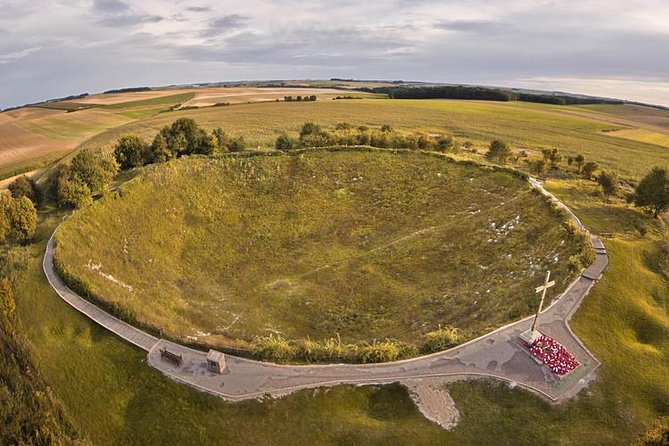
The first stop is Lochnagar Crater in La Boisselle. This is one of the huge mine craters made by British tunneling companies on July 1, 1916, when the Battle of the Somme began. It’s dramatic from the outside, but what makes it memorable is the specific operation behind the crater.
The mine was placed beneath the German front lines, part of a wider plan using multiple mines to help infantry advance at the start of the battle. The British named it after Lochnagar Street, a British trench where the Royal Engineers tunneling companies dug. According to the on-site narration, the shaft went down about 90 feet into the chalk, then stretched around 300 yards toward the German lines.
Then comes the scale: 60,000 lbs (27 tons) of ammonal explosive were loaded into two large underground chambers, positioned about 60 feet apart. The aim was to destroy a formidable German strongpoint called Schwaben Höhe, located south of La Boisselle in the Somme department.
What I like about this stop for your own visit: the crater is not just a photo spot. The details help you understand why the ground looks the way it does and why it mattered tactically. If you take a minute to picture the front line above and underground operations below, the site starts to feel more real than a battlefield marker.
Practical consideration: this is mostly an outdoor stop. Wear comfortable shoes and be ready for early-morning cold or damp depending on the season, since the tour notes it needs good weather to run.
Thiepval Memorial to the Missing: facing names without graves
Next is Memorial de Thiepval, the Memorial of the Missing. This massive British war monument was unveiled by the Prince of Wales in 1932, and by French state President Albert Lebrun. It commemorates more than 72,000 soldiers from the UK and Commonwealth countries whose remains were never identified, with no known graves after the Battle of the Somme.
The monument is cared for by the Commonwealth War Graves Commission, and the scale is the point. When you stand here, the battle shifts from battlefield events to human absence. The memorial is tied to the specific toll of the Somme, with 1,200,000 casualties recorded between July 1 and November 18, 1916.
The tour gives you time to pay respects, and the visit typically runs about 30 minutes. That’s enough time to read key sections, look for family-name patterns, and understand what the monument is doing. You don’t need to rush, but you also won’t get lost in a museum setting.
A balanced way to approach this stop: if you want something light, this is not it. If you want clarity and honesty, this is one of the most direct ways to understand what it means for soldiers to be missing. I’d treat your time here as part remembrance, part historical orientation.
Time saver tip: before you go, decide whether you want to focus on a few names and sections, or read more broadly. With limited hours in the day, focus helps you get something lasting.
Historial de la Grande Guerre in Thiepval: the 60-metre mural tells the day
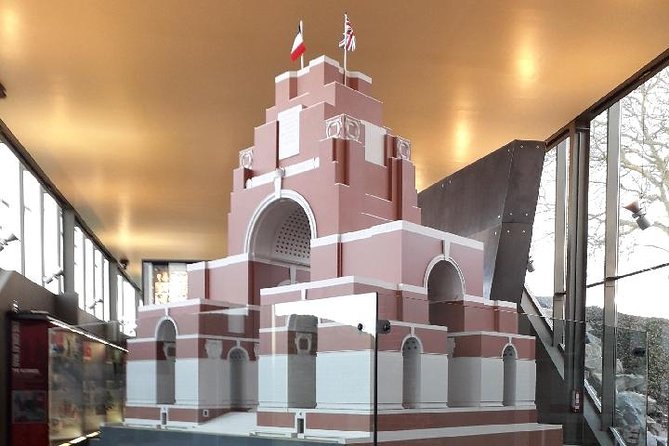
After Thiepval Memorial, you get entry to Historial de la Grande Guerre, Musée de Thiepval. This is the museum stop that helps you connect all the outdoor sites you’ll see later.
The experience starts with a large animated map at the entrance, supported by period photographs and film. This helps you get your bearings fast, because the Somme battlefield can feel confusing if you only know it as a single event from a textbook.
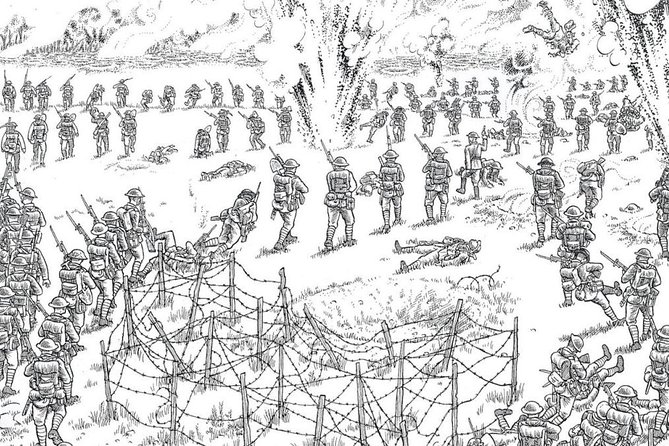
The centerpiece is a panoramic mural by illustrator Joe Sacco. It depicts the harrowing day of July 1, 1916, hour after hour. The mural runs over 60 metres of back-lit glass, so you’re not just reading labels. You’re looking at a long timeline of action spread across the room.
Then there’s a different kind of realism in the museum: a vast display pit covered by glass showing collection pieces and archaeological remains. Short videos fill in context, including commentary on scenes, historical information, archive footage, and educational animations.
You’ll also see a Maxim machine gun captured by a British regiment at Thiepval. That matters because it connects to how heavily Germans defended this location. Thiepval ridge was an Allied objective of July 1, 1916, but it wasn’t taken until the end of September, a useful reminder that big plans often collide with stubborn reality.
The exhibition also examines the creation of heroic figures. One of the standout elements is a life-size replica of the aeroplane belonging to Georges Guynemer, plus portraits of WW1 aviators. It’s a shift from trenches to the air war, tied to how aviation began to shape ideas of heroism during the conflict.
Why this museum is strong value on a day trip: the included entry time (about 45 minutes) makes it efficient. You get a guided-style narrative structure without needing to spend hours in a full museum day.
Watchouts: museums move fast when you only have one shot. If you want to read every panel, you might feel rushed. If you’re happy absorbing the big story first, then using the outdoor stops to reinforce it, 45 minutes is about right.
Ulster Memorial Tower and Thiepval Wood: a front line you can locate
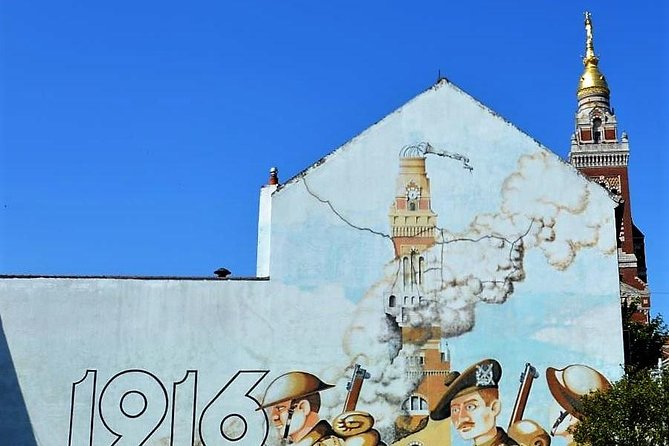
The next stop is the Ulster Memorial Tower and Thiepval Wood area. The Ulster Memorial Tower stands on what was the German front line during the Battle of the Somme from July to November 1916. That alone makes it feel like more than a viewpoint. You’re standing where the enemy’s line was, then looking across the geometry that shaped the fighting.
The tower was erected on the site of Schwaben Redoubt, a strongly fortified German position. The Ulster Division eventually captured it, which is why this memorial focuses on that unit’s role. The tower is opposite Thiepval Wood from where the 36th (Ulster) Division made its historic charge on July 1, 1916.
This is a relatively short stop, around 15 minutes, and that’s normal for a battlefield route. The goal is to connect the dots, not to spend an hour in one spot. Still, even in a quick visit, the location cues matter.
How to make this stop work for you: picture the ridge, the wood, and the direction of movement. When the guide explains where the charge began relative to the tower, your mental map improves dramatically. That’s the moment a day trip becomes more than sightseeing.
Practical note: outdoor memorials can be windy and cool. Bring a layer you can handle outdoors for a quick walk.






Beaumont-Hamel Newfoundland Memorial Park: preserved trenches and a brutal toll
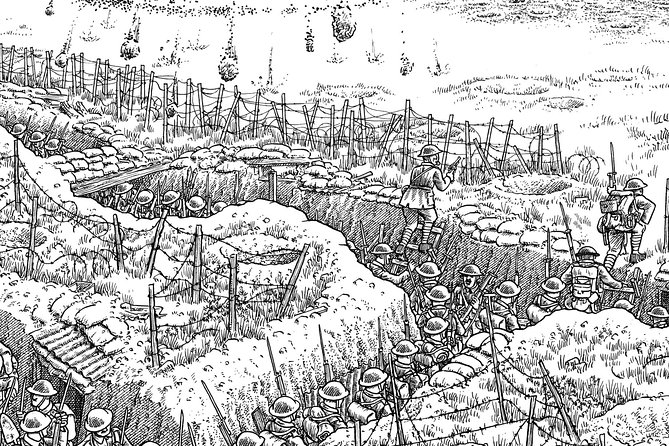
The final stop is the Newfoundland Memorial Park in Beaumont Hamel. This is a preserved battlefield area, and the difference shows up immediately when you walk through it.
About 74 acres have been preserved, including original trench networks. Instead of just looking at markers, you get to walk through the preserved layout and see scars of the battle that still remain on the ground.
This memorial site commemorates Dominion of Newfoundland forces members killed during World War I. It specifically marks the grounds over which the Newfoundland Regiment launched an unsuccessful attack on July 1, 1916.
One of the most specific details given is the timeline of the attack. At 8:45 a.m., the Newfoundland Regiment and the 1st Battalion of the Essex Regiment received orders to move forward. Of the 780 men who went forward, only about 110 survived unscathed, and only 68 were available for roll call the following day.
That kind of number can feel heavy, but it’s exactly what helps this stop connect to real people rather than abstract events. A preserved battlefield makes those losses easier to visualize.
The tour gives about one hour here, and that’s good. Beaumont-Hamel is a place where you might want to pause often. If your family or group needs a break, use it here, not earlier in the day.
Why I think this stop is so strong for visitors: it’s one of the few moments where you can walk a battlefield rather than just stand beside it. If you want a Somme day trip that ends with something more than stone and names, this park delivers.
Price and value: what your $289.82 is really buying
At $289.82 per person, this is not the cheapest way to see WW1 sites from Paris. But the pricing makes sense when you break down what you get that you would otherwise have to figure out yourself.
You’re paying for:
- round-trip day trip transportation in an air-conditioned vehicle
- a driver guide
- included museum admission to Historial de la Grande Guerre in Thiepval
- included admission to the Thiepval Memorial area museum experience listed as the Thiepval museum entry
- multiple additional memorial stops, where the outdoor entries are free
The biggest value isn’t just the tickets. It’s the structure. One day, one route, and a guide who can explain why each stop fits into the larger Somme story.
The small-group size also helps you get more out of a fixed schedule. When you’re capped at eight travelers, you tend to lose less time asking follow-ups or waiting while people catch up.
How to judge if it’s a good fit for you: if you’re the kind of visitor who wants context, and you don’t want to plan transport across rural sites, this is a solid deal. If you already know the terrain deeply and prefer to travel independently, then you may find your own schedule cheaper. But most people visiting from Paris are doing this for the guidance and efficiency.
Getting the most out of a 12 to 13 hour WW1 day trip
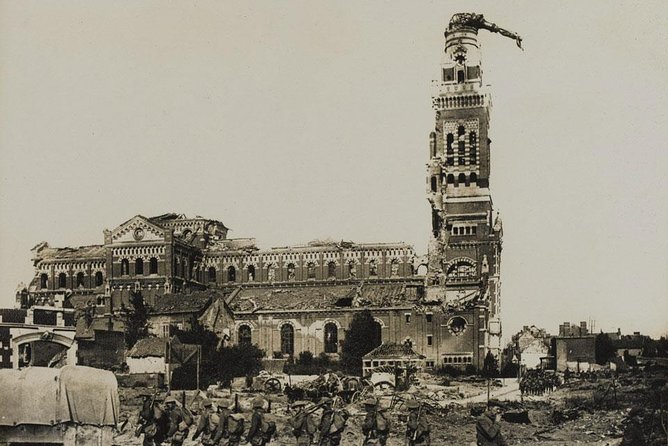
This is a long day, and comfort matters. You’re leaving early, spending time outdoors, and getting museum time mixed with memorial time.
Here’s what I recommend so you feel good by the time you reach Beaumont-Hamel:
- wear walking shoes you can stand in for long periods
- bring a layer for the morning and for windy outdoor stops
- plan your lunch since lunch is not included
- bring water, especially because parts of the day are outside and walking is involved
- take advantage of the guide’s explanations at the short stops, since some sites are only 10 to 30 minutes
Also, check that you’re okay with a schedule that moves. This tour is designed for coverage of major anchors like Lochnagar Crater and Thiepval Memorial, plus the big museum stop.
The tour uses a mobile ticket, and you’ll receive confirmation at booking time. The sites are near public transportation and the day is planned so you can focus on the battlefield itself.
Who this Somme and Thiepval day trip suits best
This tour is a strong match for:
- first-time visitors to WW1 battlefields who want a coherent story
- people who want a small-group experience with time to ask questions
- families with older kids, since one recent highlight described the trip as enjoyable even for teenage daughters, guided by Regis
- anyone interested in both memorial sites and museum-based interpretation
If you’re traveling with mobility limitations, you should pay close attention to how much walking you’re comfortable doing. The tour notes that most travelers can participate, but it still includes outdoor walking through preserved trenches and crater-adjacent areas.
Should you book this Somme battlefield day trip?
I’d book it if you want the Somme from Paris in one day with minimal hassle, and you want more than a list of places. The included museum time, especially Historial de la Grande Guerre with Joe Sacco’s 60-metre panoramic mural, is the kind of interpretation that makes the outdoor stops click.
I’d think twice if you strongly dislike long days or very early mornings. You start at 6:30 am, and you’re out for about 12 to 13 hours, with limited time per site.
If you can handle that, this tour gives you a well-paced, high-impact route through Thiepval, Lochnagar Crater, Ulster positions, and Beaumont-Hamel’s preserved Newfoundland trenches.
FAQ
What time do you start and where is the meeting point?
You start at 6:30 am and meet at Théâtre du Lido, 116 Av. des Champs-Élysées, 75008 Paris. The tour ends back at the same meeting point.
How long is the day trip?
The duration is approximately 12 to 13 hours.
What language is the tour offered in?
The tour is offered in English.
What is the maximum group size?
The maximum group size is 8 travelers.
Is museum admission included?
Yes. Admission to the Historial of the Somme 1916 Museum in Albert is included, and admission to the Thiepval Museum in Thiepval is included.
Are there any sites with free admission?
Yes. The Thiepval Memorial is free, and the Ulster Memorial Tower & Thiepval Wood stop is listed with free admission. Lochnagar Crater and the Newfoundland memorial park are also listed as free admission.
Is lunch included?
No. Lunch is not included.
Is transportation included from Paris?
Yes. The tour includes an air-conditioned vehicle and a driver guide for the round-trip day trip.
Do I get a mobile ticket?
Yes, you receive a mobile ticket.
What is the cancellation policy?
You can cancel for free up to 24 hours before the experience start time for a full refund. If you cancel less than 24 hours before the start time, the amount paid will not be refunded.
More 1-Day Tours in Paris



More Tour Reviews in Paris


Not for you? Here's more nearby things to do in Paris we have reviewed











Paris City Tours, side by side.
 ★ 4.6Louvre Museum Timed-Entrance TicketTickets from $2671,977 guest reviews
 ★ 4.6Disneyland® Paris 1-Day TicketTickets from $6149,412 guest reviews
 ★ 4.6Versailles Palace and Gardens Full Access TicketTickets from $1741,579 guest reviews
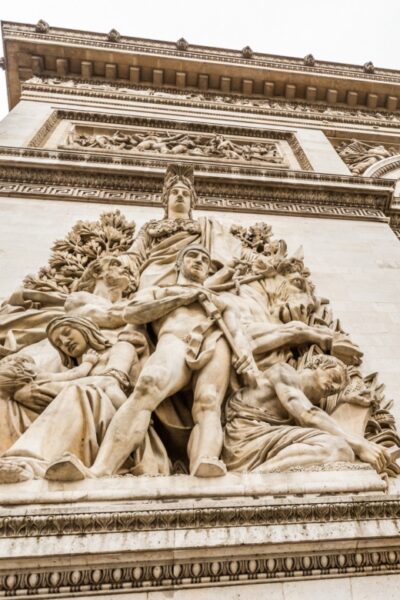 ★ 4.6Arc de Triomphe Rooftop TicketsTickets from $1834,264 guest reviews
 ★ 4.7Orsay Museum Entry TicketTickets from $1525,647 guest reviews
 ★ 4.4Evening River Cruise with MusicTickets from $2722,721 guest reviews
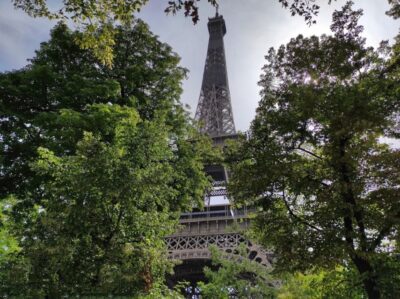 ★ 4.4Eiffel Tower Entry Ticket with Optional Summit AccessTickets from $2920,035 guest reviews
 ★ 4.3Eiffel Tower Summit or Second Floor AccessTickets from $5917,248 guest reviews
This tour also belongs to