
Review · PARIS CITY TOURS
WW1 Australians in the Somme -Villers Bretonneux, Le Hamel – Day trip from Paris
Trenches have a way of staying with you. This small-group WW1 Somme day trip turns Australian memory into a real route on the ground, with a guide’s focused commentary on Australia’s role in the Western Front. I like that it keeps the group to seven people, so you get time to ask questions, read the memorial panels properly, and not feel rushed between sites.
One consideration: it is a long day, starting at 6:30am and running about 12 to 13 hours, and lunch is not included. If you need food breaks at specific times, you’ll want to plan ahead.
Key things that make this Somme tour work
- Max 7 people means you actually move like a small team, not a crowd
- Australian WW1 focus across multiple memorials, not a generic “Somme highlights” loop
- Free admission stops at key sites, so your money goes mostly toward transport and guiding
- Trench-era details explained clearly, including preserved trenches and the Lochnagar mine site
- Péronne museum included in a medieval setting, with trench art collections like Otto Dix
A Small-Group WW1 Somme Day Trip With a Clearly Australian Route
If you care about WW1 history but hate feeling lost in it, this kind of day trip is a smart fix. The Somme region is big, and most self-guided routes can turn into a logistics puzzle. Here, the route is built around Australian remembrance, so the story stays connected from stop to stop.
The best part is the human scale. With a group capped at seven, your guide can manage pacing, answer questions, and keep you from spending half your day trying to figure out where to stand and what to read. From there, the day becomes a chain of specific places, each tied to a battle moment or a part of the Australian war experience.
You also get a mix that works: memorials outdoors, crater ground-level reality, preserved trench remnants, then a museum stop to put it all into context. That balance matters. Pure battlefield walking can feel emotionally heavy without interpretation. Pure museum time can feel abstract. This itinerary aims for both.
More Paris tours and experiences for the shortlist

The 6:30am Paris Start, and Why It Matters
This tour starts at 6:30am at the Théâtre du Lido on the Champs-Élysées area (116 bis Av. des Champs-Élysées). Expect a full day, about 12 to 13 hours, returning to the same meeting point.
That early start is not random. It buys you quieter access at memorials and reduces time pressure on the road. In practice, it helps you actually experience each site rather than racing through them. The tradeoff is obvious: you will need to be ready for an early departure and you may not get to eat when you want unless you plan for it.
Also, your transport is an air-conditioned vehicle, which is a real comfort factor in warm or changeable weather. Good weather is required for the experience, so on misty or poor days, you might be offered another date or a full refund.
Villers-Bretonneux Australian National Memorial: Names, Missing Graves, and a Lutyens Tower
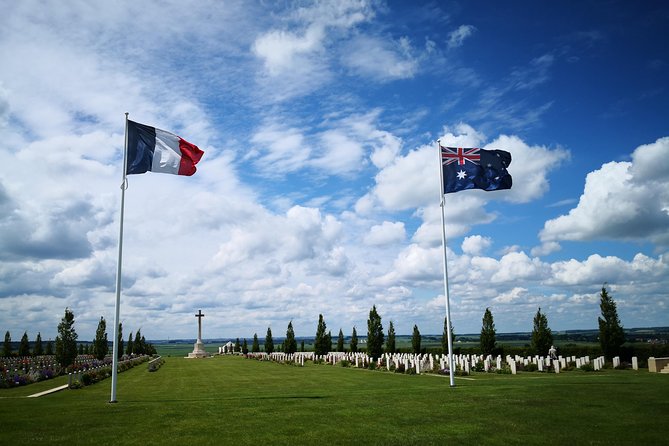
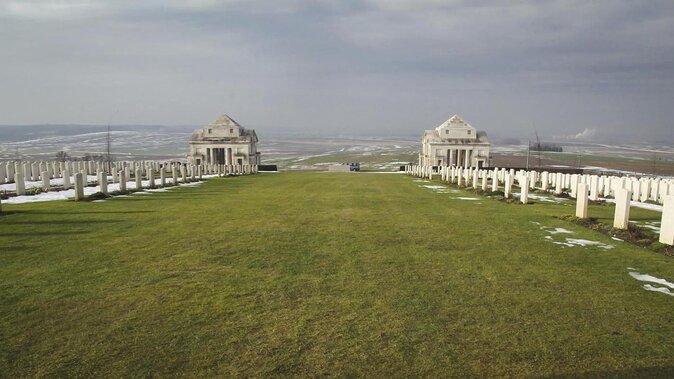
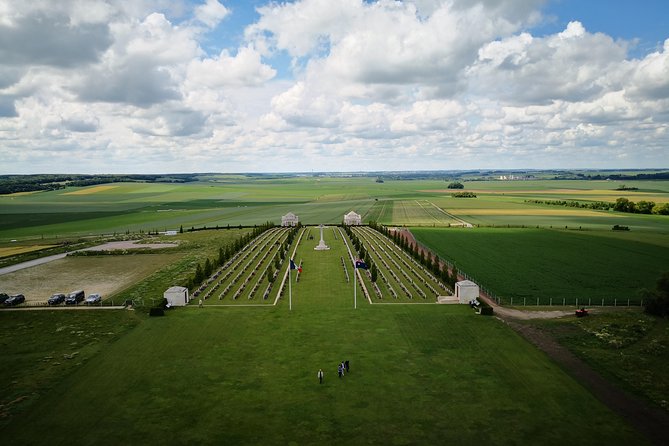
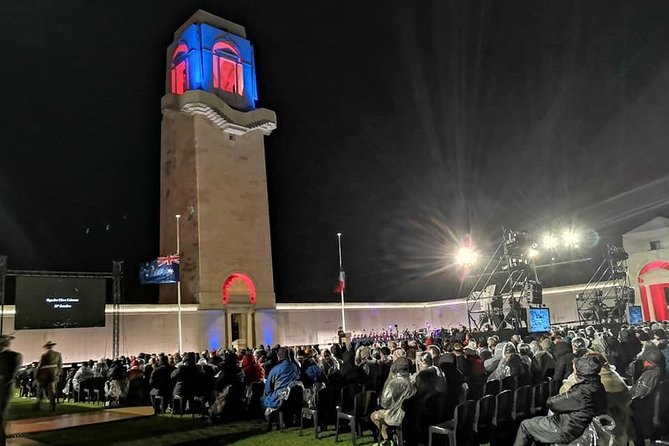
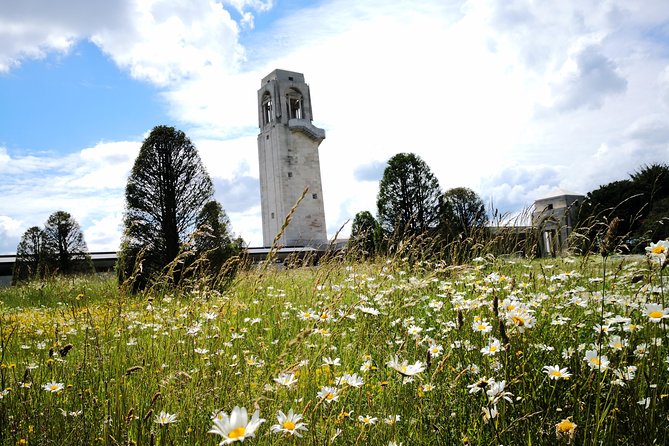
The day’s first major emotional anchor is the Australian National Memorial in Villers-Bretonneux. This is the main memorial for Australian military personnel killed on the Western Front with no known grave. It carries 10,773 names of men of the Australian Imperial Force, killed from 1916 onward, when Australian forces arrived in France and Belgium, to the end of the war.
The details here are what make it powerful. The memorial is designed by Sir Edwin Lutyens, and the structure is a tower inside the Villers-Bretonneux Military Cemetery. It also includes the Cross of Sacrifice, tying the memorial to the wider Commonwealth War Graves Commission tradition. Your guide’s commentary is especially useful at this stop, because you’re not just looking at a pretty stone landmark. You’re reading a roll of names and understanding why this location matters to Australian memory, including its connection to the Second Battle of Villers-Bretonneux (24 to 27 April 1918).
Practical note: the stop is about 40 minutes, and admission is free. That is enough time to take in the overall memorial, then step into the cemetery space and read a few sections carefully. If you’re the type who wants to pause at every inscription, 40 minutes can feel short, but the tour’s overall pacing tries to keep the day moving.
Le Hamel Australian Corps Memorial: Monash, Combined Arms, and Preserved Trenches
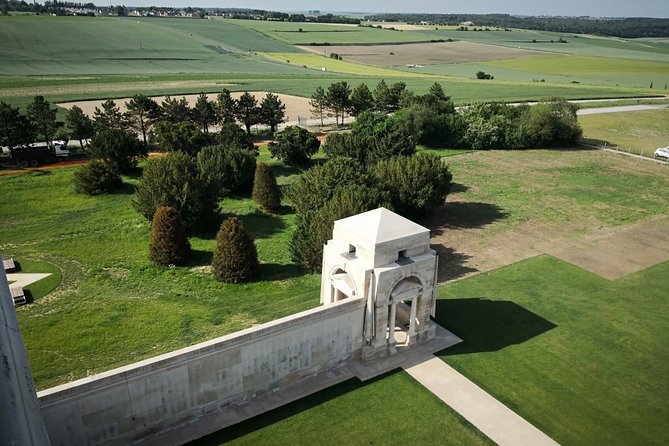
Next is the Australian Corps Memorial at Le Hamel, focused on the battle of 4 July 1918. This stop is not only about remembering the dead. It also helps you understand what made the battle different.
The key story: with American support, General Monash launched a hugely successful attack that combined infantry, artillery, air forces, and tanks, described as a first for modern warfare tactics. Standing in the memorial park, you’re reminded that the Somme is not one single style of fighting. It evolves, and the Australian experience is part of that change.
The site was created by the Australian state and inaugurated in 7 August 1998. It includes panoramic displays and explanatory panels, plus several trenches preserved. Those preserved trenches matter because they give you something photos and maps cannot. You can see how ground shape affects movement, visibility, and the idea of holding and advancing under pressure.
Time is about 30 minutes, and admission is free. This is a good stop for people who like “meaning plus location,” not just names and dates.
Lochnagar Crater: Standing at the 1916 Mine Site
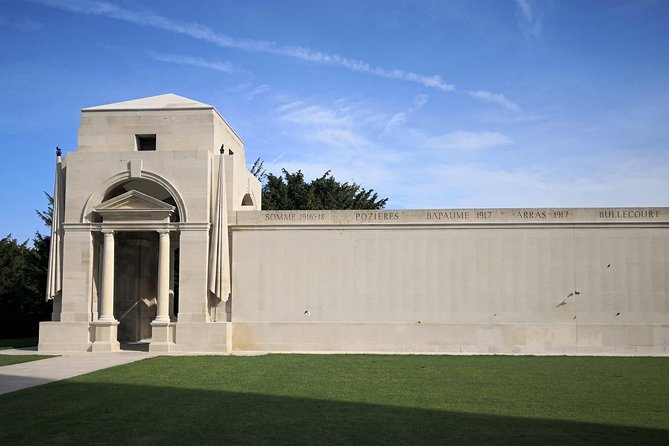
Then comes one of the most visually striking places on this route: Lochnagar Crater near La Boisselle in the Somme department. This is where the Somme becomes physical in a way that still hits.
Here’s the core context. The Lochnagar mine was an underground explosive charge, secretly planted by the British for the 1 July 1916 opening day of the Somme. Tunnelling companies worked under German fortification known as Schwabenhöhe. The British named it after Lochnagar Street, the trench from which the gallery was driven.
The mine was sprung at 7:28 a.m. on 1 July 1916, creating a crater about 30 meters deep and 100 meters wide. British troops captured and held it, and the attack on the flanks faced resistance from German small arms and artillery fire, with limited success on the extreme right and just south of La Boisselle.
The crater is preserved as a memorial. There is also a religious service held each 1 July, which adds an annual rhythm to how the site is remembered.
This stop is shorter, about 10 minutes, and admission is free. That can be perfect if you want to see the scale and then keep going. If you’re a slow reader, pair this with the guide’s explanation so you understand what you’re looking at during those quick minutes.



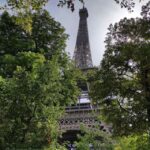

Pozières Windmill Memorial: Australian Sacrifice and a Link to Canberra
At Pozières, you’ll visit the Windmill site, established as an Australian memorial in the 1930s at the suggestion of Charles Bean, Australia’s official war historian. Bean described the Windmill ridge as a place more densely sown with Australian sacrifice than anywhere else on earth.
The battle context helps you make sense of why this particular site became a memorial. During seven weeks in 1916, the Australian Imperial Force suffered 23,000 casualties, with more than 6,700 deaths, in the countryside around the Windmill.
There’s also a tie to home that many visitors find unexpectedly moving. On 11 November 1993, soil from the Windmill site was cast over the coffin of Australia’s Unknown Soldier during the funeral at the Australian War Memorial in Canberra. That connection turns a French battlefield location into something part of Australia’s national remembrance.
Time is about 10 minutes, admission is free. This is brief but meaningful. It pairs well right after Lochnagar because the day shifts from one dramatic action site to a broader sense of cost and endurance.
Mont Saint-Quentin’s 2nd Australian Division Memorial: Art, Damage, and Rebuilding
Another quick but worthwhile stop is the 2nd Australian Division Memorial on the road from Bapaume to Péronne in the Mont Saint-Quentin area. It’s described as the only one of the five Australian division memorials initiated by members of the division themselves.
The base was erected in 1925, and the bronze bas-reliefs were created by May Butler-George. The scenes include men hauling and pushing a gun, and men advancing with bayoneted rifles and hand grenades. The sculptor is Charles Web Gilbert, and the top figure thrusts a bayonet through a German eagle, a very clear symbol of the era’s monument language.
Then comes an important historical detail. In 1940, German soldiers smashed the memorial. A replacement statue by Stanley Hammond was erected in 1971, showing a thoughtful Australian soldier looking down. That rebuild story is a reminder that monuments are not just art. They can be targets in changing political realities, too.
This stop is about 10 minutes, admission free. In that short time, your guide’s pointing out of the sculpture choices helps it land. Otherwise, it can be easy to treat it like another roadside marker.
Historial de la Grande Guerre in Péronne: Uniforms, Weapons, and Trench Artists
After lunch break time (lunch is not included), the day ends with a more reflective component: free access to the Historial de la Grande Guerre museum in Péronne, with admission included.
This museum is housed in a 13th-century medieval castle, which does something subtle to your experience. You’re not in a sterile modern building. The setting makes the exhibits feel more grounded, like the past is literally holding the space.
Inside, you’ll see large exhibits of uniforms and weapons worn and used by soldiers during the conflict. That is one of the best ways to make the battle details concrete. It is easier to understand descriptions of conditions and tactics when you can see the gear.
You’ll also find a permanent collection of trench artists, including work by Otto Dix. Trench art matters because it shows how soldiers processed horror with pencil and ink, sometimes with graphic testimony. It turns the story from a sequence of battles into the reality of human perception under extreme stress.
Time here is about 1 hour. That’s enough for a solid overview without turning the final part of the day into museum fatigue.
Price and Value: What You Get for $300.06 Per Person
At $300.06 per person, this is not a budget impulse buy. But it is also not just a ride to a couple of famous spots.
Your price includes an air-conditioned vehicle, a driver guide, and admission to the Historial de la Grande Guerre in Péronne. Meanwhile, several of the outdoor memorial stops are free to enter. That mix tells you where the cost is going: logistics, time management, and interpretation.
The value shows up most for people who want meaning without planning stress. The route covers multiple key locations tied directly to Australian WW1 remembrance, and your guide handles navigation and the flow. If you tried to reproduce this on your own, you would spend time figuring out driving routes, parking, and timing. That can easily eat a whole day and still leave you without the battle-specific explanations that connect the stops.
The other value signal is the group size. Paying for a small group is often how you avoid “stand in line, look, move on” tourism. Here, the seven-person limit supports a more personal pace.
The cost consideration is lunch not being included. If you skip lunch or under-plan your food, the day can feel harder than it should. Bring snacks you can eat quietly between stops, or budget for a meal on your own during the day.
Who This Somme Day Trip Suits Best
This tour fits best if you want an Australian-focused WW1 route from Paris with clear guidance and limited group size. It is a good match for history lovers who appreciate context, and for families with teenagers who can handle a moving, serious day.
It’s also a solid choice if you do not want to manage the day’s driving, timing, and reading of memorial panels by yourself. With the guide handling the logistics and commentary, you can focus on the places and the story.
If you prefer total independence, you might find the structured pacing limiting. But for most people, the structure is what makes the route workable in one day.
Should You Book This Paris to Somme WW1 Australian Memorial Day Trip?
If you’re weighing this against a larger, faster group tour, I’d lean toward this one. The small group size, the Australian-specific route, and the combination of outdoors memorial sites plus the Péronne museum make it feel like a complete day, not a checklist.
Book it if you want a guide who can connect the dots between sites, and you value time on the ground at memorials that are free and deeply readable. Skip it if you need a long, flexible lunch plan, or if a 12 to 13 hour day starting at 6:30am sounds like too much.
Also, if you’re traveling at a time when weather can change, keep an eye on forecasts. Since good weather is required, you may need the flexibility to shift dates if conditions force a change.
FAQ
What is included in the tour price?
The tour includes an air-conditioned vehicle, a driver guide, and admission to the Historial de la Grande Guerre in Péronne.
Is lunch included?
No. Lunch is not included.
How long is the day trip, and what time does it start?
It runs about 12 to 13 hours and starts at 6:30am. The meeting point and end point are the same location at the Théâtre du Lido (116 bis Av. des Champs-Élysées, 75008 Paris).
What group size and language should I expect?
The tour is offered in English and is limited to a maximum of seven travelers.
Are the memorial sites free to enter?
Admission is free for the memorial stops listed, including Villers-Bretonneux, Le Hamel, Lochnagar Crater, Windmill Memorial, and the 2nd Australian Division Memorial. Museum admission to the Historial de la Grande Guerre is included.
What happens if the weather is poor or I need to cancel?
The experience requires good weather. If it is canceled due to poor weather, you’ll be offered a different date or a full refund. Cancellation is free up to 24 hours in advance of the experience start time for a full refund. If you cancel less than 24 hours before, the amount paid will not be refunded.
More 1-Day Tours in Paris



More Tour Reviews in Paris

Not for you? Here's more nearby things to do in Paris we have reviewed











Paris City Tours, side by side.
 ★ 4.6Louvre Museum Timed-Entrance TicketTickets from $2671,977 guest reviews
 ★ 4.6Disneyland® Paris 1-Day TicketTickets from $6149,412 guest reviews
 ★ 4.6Versailles Palace and Gardens Full Access TicketTickets from $1741,579 guest reviews
 ★ 4.6Arc de Triomphe Rooftop TicketsTickets from $1834,264 guest reviews
 ★ 4.7Orsay Museum Entry TicketTickets from $1525,647 guest reviews
 ★ 4.4Evening River Cruise with MusicTickets from $2722,721 guest reviews
 ★ 4.4Eiffel Tower Entry Ticket with Optional Summit AccessTickets from $2920,035 guest reviews
 ★ 4.3Eiffel Tower Summit or Second Floor AccessTickets from $5917,248 guest reviews
This tour also belongs to